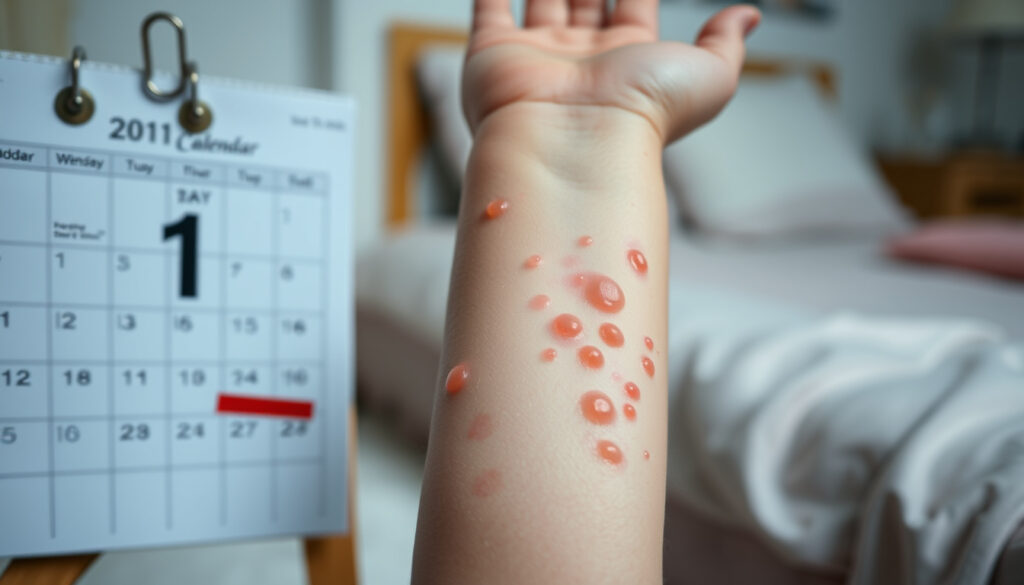
Early Stage Chicken Pox: Symptoms, Day 1, and Rash Progression
When a fever, headache, and unusual tiredness show up without warning, the natural assumption is a cold or flu. But those symptoms can also be the earliest clues of chickenpox — often appearing a full day or two before any rash. Knowing how to spot early stage chicken pox from day one helps you act quickly, reduce spread, and manage discomfort before the rash takes hold.
Incubation period: 10–21 days ·
Prodrome symptoms start: 1–2 days before rash ·
Average rash duration: 5–10 days ·
Stages of rash: 3 ·
Contagious period: 1–2 days before rash until all blisters crusted
Quick snapshot
- Fever, tiredness, loss of appetite, headache (CDC (U.S. Centers for Disease Control and Prevention))
- Small red spots appear on face, chest, back (NHS (UK National Health Service))
- Spots are flat initially, become raised (GoodRx (healthcare information platform))
- Spots become fluid-filled blisters (KidsHealth (Nemours children’s health system))
- Intense itching (HSE (Ireland’s Health Service Executive))
- Blisters dry and form crusts (Seattle Children’s Hospital (pediatric research hospital))
- Scabs fall off in 1–2 weeks (Mayo Clinic (academic medical center))
Six facts capture the rhythm of early-stage chickenpox most clearly:
| Fact | Value |
|---|---|
| Incubation period | 10–21 days |
| Prodrome before rash | 1–2 days |
| Rash duration (active) | 5–10 days |
| Rash stages | 3 |
| Contagious start | 2 days before rash |
| Contagious end | When all blisters crusted |
The pattern: these numbers define the window for isolation and treatment decisions.
How to know if chickenpox is starting?
Prodrome symptoms before the rash
Chickenpox doesn’t announce itself with spots first. The CDC (U.S. Centers for Disease Control and Prevention) lists fever, tiredness, loss of appetite, and headache as the early signs that emerge 1 to 2 days before the rash. These can feel like a generic viral illness, making it easy to miss. Mayo Clinic (academic medical center) adds that loss of appetite is a common early marker, especially in children.
Fever, tiredness, loss of appetite, headache
The prodrome usually lasts 2–3 days according to Chickenpox Aware (Irish health awareness initiative), but the fever can spike on day 4–5 of the rash. The key clue: if any of these symptoms appear and you’ve been exposed to chickenpox within the past 10–21 days, it’s worth watching closely.
The implication: catching the prodrome means you can isolate before the contagious window fully opens.
What does chicken pox look like when first starting?
Stage 1: small spots
The rash begins as small red spots — often on the chest, back, and face first, then spreading outward, per the CDC (U.S. Centers for Disease Control and Prevention). GoodRx (healthcare information platform) describes them as flat at first, then quickly becoming raised. These spots can appear inside the mouth or on the eyelids.
Stage 2: blisters
Within hours, the raised spots fill with clear fluid, turning into thin-walled blisters. KidsHealth (Nemours children’s health system) notes that the blister walls break easily, leaving open sores. The HSE (Ireland’s Health Service Executive) specifies that blisters are intensely itchy.
Stage 3: scabs
Open sores dry and form brown crusts. Seattle Children’s Hospital (pediatric research hospital) outlines five sub-stages (red bumps → water blisters → cloudy blisters → open sores → dry crusts) that can all appear within 24 hours on the same person. The NHS (UK National Health Service) says the full cycle takes about 5–10 days.
Seeing bumps, blisters, and scabs all at once is normal for chickenpox — new crops keep appearing for 4–5 days (Mayo Clinic (academic medical center)). This simultaneous presentation is a signature trait that helps distinguish it from other rashes.
The pattern: three stages that overlap in time, not neat sequential phases.
What is mistaken for chicken pox?
- Hand, foot, and mouth disease — causes blisters on palms and soles, not common on trunk.
- Impetigo — honey-colored crusts, not fluid-filled blisters.
- Insect bites — fewer lesions, usually isolated; no fever.
- Scabies — intense itch with burrows between fingers, no systemic fever.
- Shingles — localized painful rash on one side of body, not widespread.
CDC (U.S. Centers for Disease Control and Prevention) notes that an RSV rash can appear as a fine pink maculopapular rash, but it lacks the fluid-filled blisters of chickenpox. Clinical diagnosis is usually straightforward once the rash is fully developed.
The catch: without the blister stage, look-alikes can delay correct identification.
What is the worst day with chicken pox?
Peak severity timeline
Day 4–5 after the first spots is typically the most intense. The CDC (U.S. Centers for Disease Control and Prevention) states the rash is most abundant and the fever highest during this window. CityMD (urgent care provider) adds that itching peaks on days 3–5, when hundreds of blisters may be present.
Fever peaks on day 4–5
High fever (up to 102°F/39°C) is common. Mayo Clinic (academic medical center) advises monitoring for signs of bacterial infection (pus, spreading redness) which can complicate the peak days.
Itching worst on day 3–5
The itching can be severe enough to disrupt sleep. Keep nails short, use calamine lotion, and consider antihistamines recommended by a pharmacist or doctor.
Adults may experience higher fever and more extensive rash than children. If you’re over 18, have a weakened immune system, or are pregnant, contact a healthcare provider early — antiviral treatment is most effective within 24–48 hours of rash onset.
The implication: planning for the worst days helps caregivers manage symptoms proactively.
How can you confirm chickenpox?
Clinical diagnosis by doctor
Most cases are diagnosed by a doctor based on the classic rash history and appearance. The CDC (U.S. Centers for Disease Control and Prevention) says lab tests (PCR of lesion fluid or serology) are usually reserved for atypical cases or when confirmation is needed for public health or pregnancy management.
Lab tests (PCR, serology)
PCR is highly sensitive and can detect varicella-zoster DNA. Mayo Clinic (academic medical center) notes that blood tests for antibodies can also indicate recent infection.
When to see a doctor
- Fever above 102°F (39°C) or lasting more than 4 days
- Rash that becomes warm, tender, or starts oozing green/yellow fluid (possible bacterial superinfection)
- Difficulty breathing, severe headache, confusion
- Pregnant women, newborns, and immunocompromised individuals should seek medical advice early
The implication: early diagnosis doesn’t change the typical course, but it lets you isolate before the contagious window fully opens.
Timeline of early stage chicken pox
- Day -2 to 0: Prodrome — fever, tiredness, headache, loss of appetite
- Day 1: First small red spots appear on face/trunk (NHS (UK National Health Service))
- Day 2-3: Spots become raised, fluid-filled blisters; peak of new spots (KidsHealth (Nemours children’s health system))
- Day 4-5: Worst day — most blisters present, high fever, intense itching (CDC (U.S. Centers for Disease Control and Prevention))
- Day 5-10: Blisters dry, form scabs; scabs fall off (Seattle Children’s Hospital (pediatric research hospital))
- After day 10: Usually no longer contagious once all scabs formed (HSE (Ireland’s Health Service Executive))
The pattern: this timeline gives families a concrete roadmap for what to expect each day.
Clarity check
Confirmed facts
- Chickenpox rash progresses through specific stages: spots → blisters → scabs (Mayo Clinic (academic medical center))
- Incubation period is 10–21 days (CDC (U.S. Centers for Disease Control and Prevention))
- Prodrome symptoms precede rash by 1–2 days (CDC (U.S. Centers for Disease Control and Prevention))
- Highly contagious from 1–2 days before rash until all blisters crusted (NHS (UK National Health Service))
What’s unclear
- Exact day when symptoms peak can vary by individual
- Adults may experience more severe symptoms but data on precise severity distribution is limited
- Visual differentiation from other rashes can be ambiguous without lab tests
What experts say
“Typical symptoms that may begin to appear 1 to 2 days before rash include: Fever Tiredness Loss of appetite Headache”
CDC (U.S. Centers for Disease Control and Prevention)
“The main symptom of chickenpox is an itchy, spotty rash. Chickenpox happens in 3 stages.”
HSE (Ireland’s Health Service Executive)
“Stage 1: small spots appear · Stage 2: the spots become blisters · Stage 3: the blisters become scabs.”
NHS (UK National Health Service)
Recognizing early stage chicken pox is largely about pattern recognition — the prodrome warning, the overlapping rash stages, and the predictable timeline. For parents and adults facing the first signs, the challenge is distinguishing this from other common viruses. The two-day contagious before the rash means isolation decisions must be made early and based on exposure history.
For anyone in close contact with an infected person, the choice is clear: monitor for fever and spots, reduce contact with vulnerable individuals, and if you’re an adult or planning pregnancy, discuss post-exposure prophylaxis with your doctor.
For a more detailed breakdown of the rash progression and isolation guidelines, see this guide on early stage chicken pox symptoms.
Frequently asked questions
Can adults get chickenpox twice?
It is extremely rare. Most people develop lifelong immunity after one infection. Second episodes are more likely in immunocompromised individuals.
Is chickenpox dangerous during pregnancy?
Yes. Pregnant women who have not had chickenpox or been vaccinated are at risk of severe infection and complications for the baby. They should avoid exposure and contact their doctor immediately if exposed.
How long should a child stay home from school with chickenpox?
Children should stay home until all blisters have crusted and dried — usually about 5–7 days after the rash first appeared.
Can you get chickenpox if you have been vaccinated?
Yes, but it’s much less common. Breakthrough infections are usually milder with fewer than 50 spots and lower fever.
What is the difference between chickenpox and shingles?
Chickenpox is the primary infection with varicella-zoster virus. Shingles is a reactivation of the same virus later in life, causing a painful localized rash.
Are there home remedies to relieve chickenpox itching?
Calamine lotion, colloidal oatmeal baths, and keeping nails short help. Antihistamines like cetirizine may reduce itching. Avoid aspirin in children.
When do chickenpox scars form and how to prevent them?
Scars form when blisters are scratched and become infected. Prevent by keeping skin clean, applying calamine, and using antihistamines to reduce scratching.
More related posts
 Christian Dating for Free: Honest Review of Top Sites
 What Does IKEA Sell? Furniture, Home Goods, Food & More
 Bed Bath and Beyond Rotorua: Hours, Sales & Online Shopping
 New World Easter Eggs 2026: Rare, Unhealthy & Best Eggs to Buy
 Jamie and Eliot MAFS: Relationship Status and Drama
 Barry Shepherd Taupō Police: 50 Years of Service & Insights
 Trade Me Insurance Login: Access Account & File Claims
 Soul Bar and Bistro – King West Toronto Guide