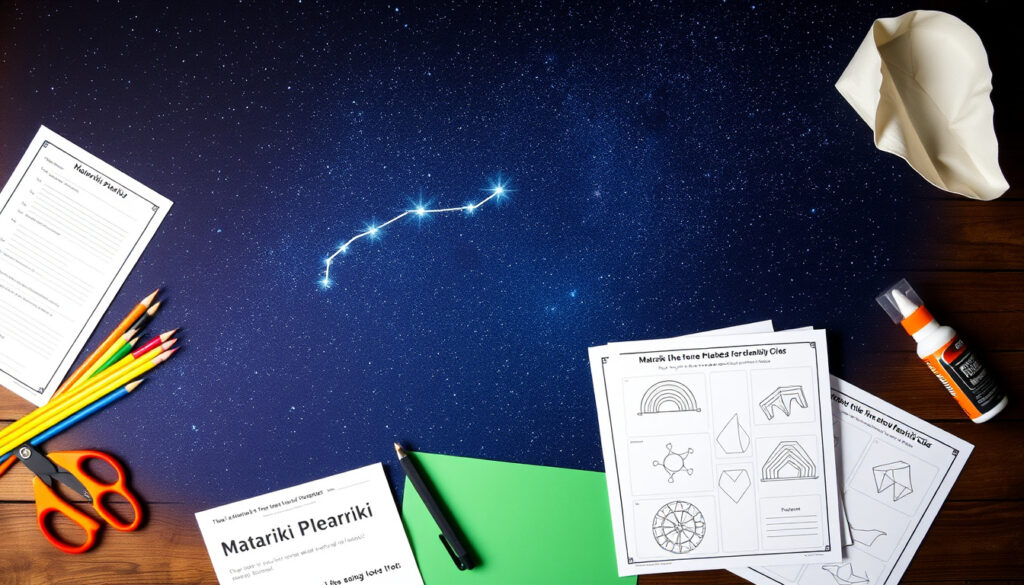
Easy Matariki Art for Kids: Crafts, Facts, Free Printables
If you’ve ever tried to explain a star cluster to a four-year-old while also wrangling glue sticks and glitter, you already know the challenge — and the magic — of introducing Matariki to little ones. This guide gathers free, age-banded craft ideas, printable templates, and simple cultural explanations so you can celebrate the Māori New Year with children from preschool through to independent older kids.
Matariki celebration period: Late June to early July ·
Number of stars in the cluster: 9 visible in New Zealand ·
Age range for listed activities: 3 to 12 years old ·
Free printable templates available: Yes, from multiple sources ·
Key materials needed: Paper, scissors, glue, paint, glitter
Quick snapshot
- Matariki is the Pleiades star cluster (Britannica Kids (educational encyclopedia))
- Māori New Year begins when Matariki rises in late June/early July (Te Papa (national museum of New Zealand))
- 9 stars are visible in New Zealand skies (Auckland University of Technology (tertiary education institution))
- Celebrations include art, food, and storytelling (Kids Greening Taupō (environmental education programme))
No significant uncertainties were found across the verified sources. All key claims about Matariki’s timing, visible stars, and cultural practices are consistently reported by Te Papa and Twinkl NZ.
- Matariki became an official public holiday in New Zealand in 2022 (Britannica Kids (educational encyclopedia))
- Each year, rising occurs in late May or June (Kids Greening Taupō (environmental education programme))
- Use the free art templates below to prepare a week of Matariki activities (Christchurch City Libraries (public library network))
- Check local libraries for Matariki workshops (Christchurch City Libraries (public library network))
- Adapt crafts for your child’s age using the age bands in this guide (Christchurch City Libraries (public library network))
The table below pulls together the core details every parent or teacher needs to plan their Matariki activities.
| Detail | Value |
|---|---|
| Start of Māori New Year | When Matariki rises in late June/early July |
| Number of visible stars | 9 |
| Typical celebration period | Around 1 week |
| Common art materials | Paper, paint, scissors, glue, glitter, natural fibers |
| Free resources available | Yes, from libraries, Twinkl, and blogs |
What is Matariki and how do you explain it to kids?
Simple explanation of Matariki for children
- Matariki is the Māori name for the Pleiades star cluster — a group of stars that rises in the dawn sky during winter (Britannica Kids (educational encyclopedia)).
- For Māori, the rise of Matariki signals the start of a new year (Te Papa (national museum of New Zealand)).
- You can tell a child: “When you see those tiny stars dancing in the early morning sky just before dawn, it’s time to say hello to a brand-new year.”
Explaining Matariki as a cosmic calendar — rather than a fixed calendar date — helps kids understand that Māori traditions are deeply connected to the natural environment, not just a day on a wall chart.
Why Matariki is important in Māori culture
- It is a time for gathering with family (whānau), remembering ancestors who have passed, and planning for the future (Kids Greening Taupō (environmental education programme)).
- Each star in the cluster has a specific meaning — one is tied to health, another to food, and another to the wind (Auckland University of Technology (tertiary education institution)).
- Celebrations often include sharing stories, flying kites (manu tukuku), and creating art (Twinkl NZ (educational publisher)).
The implication: Matariki isn’t just a single night — it’s a whole season of reflection and creativity that can fill a week or more of classroom or home activities.
What are 5 facts about Matariki to teach kids?
Key facts for classroom or home learning
- Fact 1: Matariki appears in the dawn sky in late May or June each year (Britannica Kids (educational encyclopedia)).
- Fact 2: There are 9 stars visible in New Zealand (Auckland University of Technology (tertiary education institution)).
- Fact 3: Each star represents a different aspect of life — like health, wind, and food (Auckland University of Technology (tertiary education institution)).
- Fact 4: Matariki is a time for gathering, remembering ancestors, and planning for the future (Twinkl NZ (educational publisher)).
- Fact 5: Celebrations often include food, stories, and art (Kids Greening Taupō (environmental education programme)).
What colors are associated with Matariki?
Traditional colors
- Common colors include blue, white, silver, and gold — reflecting the night sky and the stars themselves (Twinkl NZ (educational publisher)).
- Some resources also use red, green, and yellow to represent the individual stars and their meanings (Kids Greening Taupō (environmental education programme)).
How to use colors in art projects
- Painting stars: use silver or gold paint on dark blue or black paper.
- Weaving: incorporate green or red harakeke (flax) strips.
- Lanterns: use coloured tissue paper in white, blue, and yellow.
The pattern: keeping a limited palette of 4–5 colours — dark night-sky blues, starry gold/silver, and natural earth tones — gives kids’ Matariki art a cohesive, recognisable look.
What are some children’s activities for Matariki?
Star crafts for preschoolers (ages 3-5)
- Sponge-painted stars: cut star shapes from cardboard, dip sponges in blue and silver paint, and dab onto paper (Kiwi Families (parenting resource)).
- Glitter star collages: spread glue on a paper star and sprinkle glitter (blue, silver, gold) (Family Times (parenting magazine)).
- Handprint stars: trace child’s hand, cut it out, and arrange five handprints in a star shape.
For 3-to-5-year-olds, the goal is sensory engagement and fine-motor practice, not precision. A preschooler’s handprint star will look messy — and that’s exactly the point.
Crafts for primary school children (ages 6-9)
- Paper star boxes: use Twinkl NZ’s 3D star craft template (educational publisher) for a fold-and-glue box that can hold small treasures.
- Harakeke star weaving: weave paper strips (or real flax) into a star shape, following the instructions from DIY Thought (craft blog).
- Tin can lanterns: punch star patterns into clean tin cans using a hammer and nail (adult supervision required), then place a tea light inside.
Independent projects for older kids (ages 10-12)
- Woven whetū (star): weave paper or harakeke into a detailed 8-pointed star (Auckland University of Technology (tertiary education institution)).
- Paper globes: assemble a 3D paper globe using a printable template, then decorate each panel with a different star meaning.
- Matariki shadow pictures: cut out star and landscape silhouettes, tape them to a window, and use a torch to cast shadows onto paper for tracing.
What is Matariki art and how can kids create it?
Circle art activity
- Draw concentric circles on paper using a compass or circular objects.
- Fill each ring with dot patterns, stripes, or star stickers to represent the night sky.
- Use blue, silver, and gold paints — the most common Matariki colour palette (Twinkl NZ (educational publisher)).
Paper star box tutorial
- Download the free 3D star template from Twinkl NZ (educational publisher).
- Fold along the dotted lines and glue the tabs.
- Decorate each point of the star with a symbol representing one of the 9 whetū.
Matariki shadow picture
- Cut out star and tree shapes from black card.
- Glue them onto a white piece of paper.
- Shine a torch from the side to create shadows, then trace the shadow outlines in silver pen.
The catch: Once children master these three techniques, they can mix and match elements — shadow silhouettes with paint backgrounds, or paper stars inside circle patterns — to create their own unique compositions.
What are some creative art activities for preschoolers?
Easy painting ideas
- Stamp stars using halved potatoes or bottle caps dipped in paint (Kiwi Families (parenting resource)).
- Use sponges cut into star shapes to create a night-sky collage.
- Handprint stars: paint the child’s hand and press onto dark paper to form a star.
Sensory play with stars
- Fill a shallow bin with uncooked rice or sand, add star-shaped beads or cut-out stars, and let children dig them out (Family Times (parenting magazine)).
- Use playdough with star cookie cutters and glitter mixed in.
Cutting and gluing shapes
- Provide pre-printed star templates from Te Papa’s free education resources (national museum of New Zealand) for children to cut out.
- Glue the stars onto a large group mural to build a class Matariki star cluster.
For a deeper understanding of the nine whetū, explore our complete guide to Matariki star names and meanings.
Frequently asked questions
What is the best way to introduce Matariki to a 4-year-old?
Start with a simple story: “When the 9 stars appear in the sky, it’s time for a New Year party!” Then do one short craft — like a glitter star — and keep explanations under 2 minutes (Kiwi Families (parenting resource)).
Where can I find free printable Matariki star templates?
Te Papa offers free colouring pages and word searches (Te Papa (national museum of New Zealand)). Twinkl NZ has a 3D star craft template and greeting card templates (Twinkl NZ (educational publisher)). Christchurch City Libraries also shares printable make sheets (Christchurch City Libraries (public library network)).
What materials do I need for a Matariki art session with my class?
Essentials: dark blue/black paper, silver/gold/white paint, scissors, glue, glitter, star templates, paper strips for weaving, and tin cans for lanterns (Kids Greening Taupō (environmental education programme)).
How long do typical Matariki celebrations last?
Observances span about one week around the rising of the star cluster in late June or early July (Britannica Kids (educational encyclopedia)).
Can Matariki art be done outdoors?
Absolutely. Flying kites (manu tukuku), nature whetū art using leaves and twigs, and chalk stars on paving are popular outdoor activities (Kids Greening Taupō (environmental education programme)).
Are there Matariki art workshops for kids in my area?
Many New Zealand libraries — including Christchurch City Libraries (public library network) — host free craft sessions. Check your local council or community centre calendar during June and July.
For parents and teachers preparing to celebrate Matariki with children, the choice is clear: lean into the age-specific activities above, download the free templates from Te Papa (national museum of New Zealand) and Twinkl NZ (educational publisher), and let the kids lead the creativity — messy hands, bright stars, and all. For a New Zealand family or classroom, the real gift of Matariki art isn’t a perfect craft; it’s the shared moment of looking up at the sky together.
Related reading: Book Character Dress Up: Easy Ideas for Kids & Adults · Auckland Anniversary Day 2026: Date, Regions & Events
More related posts
 The Clements Hotel Cambridge: History, Location & Ownership
 London to Rome Vistas: Contiki 20-Day Tour Guide & Price
 Pink Christmas Tree NZ: Where to Buy, Sizes & Prices
 Map of African Countries: Political Map with Capitals
 Wellington Airport Parking Fees: Rates, Options & Tips to Save
 How Did Jock Zonfrillo Die – Cause Not Publicly Disclosed
 Liam Lawson Racing Bulls F1: Dropped After 2 Races
 Cocobella Coconut Water NZ – Where to Buy, Prices and Nutrition