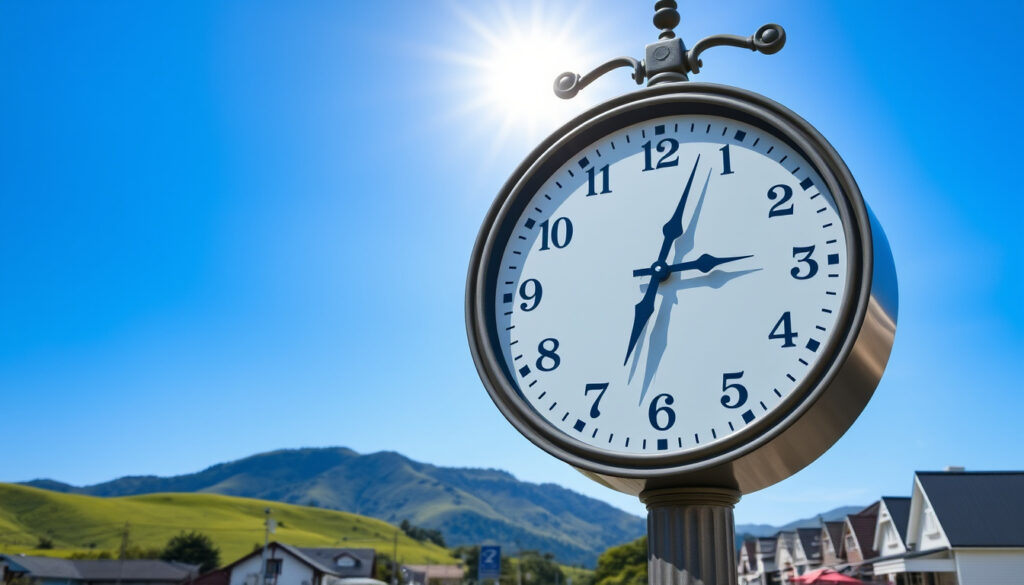
Daylight Savings NZ 2026: Dates, Clocks Forward/Back Guide
Every April and September, New Zealanders face the same two clock shifts — yet the exact dates still trip people up. The good news is that 2026’s daylight saving schedule is already confirmed, and for once, the math is straightforward. Below is everything you need, from the exact clock-change times to how Auckland will feel the shift.
DST Ends: 5 April 2026 at 3am (clocks back) ·
DST Starts: 27 September 2026 at 2am (clocks forward) ·
Location: New Zealand standard time (NZST/NZDT) ·
Auckland Impact: Sunrise/sunset shift by 1 hour on 27 Sep 2026 ·
Source: govt.nz official dates
Quick snapshot
- DST ends 5 April 2026 (time.now)
- DST starts 27 September 2026 (time.now)
- Standard last Sun Sep / first Sun Apr rule fixed since 2007 (New Zealand Government)
| Fact | Value |
|---|---|
| DST End Date 2026 | 5 April 2026, 3am |
| DST Start Date 2026 | 27 September 2026, 2am |
| Clock Action — End | Go back 1 hour |
| Clock Action — Start | Go forward 1 hour |
| DST Duration | 27 weeks (annual total) |
| Primary Source | govt.nz (official rules) |
Do clocks go forward or back for daylight savings in NZ in 2026?
New Zealand’s daylight saving rule has been unchanged since 2007: clocks move forward one hour on the last Sunday in September and move back one hour on the first Sunday in April. The official guidance from the New Zealand Government confirms this schedule applies nationwide with no regional exceptions (New Zealand Government — official rules).
September change (forward)
On Sunday, 27 September 2026, clocks jump from 01:59 to 03:00 — effectively adding an hour of daylight time to your evening. The timeanddate service confirms that NZDT (UTC+13) activates immediately after the shift. That extra hour of evening light runs for approximately 27 weeks until April. For Auckland residents, sunrise shifts from around 6:15am to 7:15am, while sunsets push well past 7pm for much of the DST period.
April change (back)
On Sunday, 5 April 2026, clocks reverse at 02:59, flipping back to 02:00 standard time. The 1News broadcast coverage notes that this “fall back” shift gives workers on the night shift at 3am an extra hour of pay — a quirk that still catches payroll departments off-guard. Auckland’s sunrise drops from roughly 6:30am back to 5:30am on the first morning after the change, trading evening light for morning brightness.
Smartphones and modern laptops usually update automatically, but standalone clocks, older microwaves, car stereos, and some smart-home devices still need a manual nudge — and that one skipped clock can throw off a week’s worth of alarms.
What are the Daylight Saving Time Changes 2026 in Auckland, New Zealand?
Auckland follows the exact same DST schedule as the rest of New Zealand. The time.now time database lists Auckland alongside Wellington, Christchurch, and every other listed region with identical dates: 27 September start and 5 April end — regional table. There are no Auckland-specific variations, despite the city being the country’s largest population centre.
Sunrise and sunset shifts
On 27 September 2026, Auckland’s sunrise moves from roughly 6:15am (NZST) to 7:15am (NZDT), while sunset pushes from around 6:00pm to 7:00pm — adding a full hour of usable evening light. By contrast, when DST ends in April, sunrise reverts to near 5:30am and sunsets fall back toward 5:45pm, trading that evening gain for brighter mornings. The NZ Herald’s coverage of past transitions notes that this seasonal see-saw is most noticeable in outdoor recreation — think after-work beach trips and sports that used to happen in fading light.
Local time impacts
- Work meetings scheduled in NZST before the September change will feel one hour earlier post-DST start
- Flight and bus timetables reference either NZST or NZDT depending on the date — double-check departure times
- Streaming and broadcast schedules typically shift programming by an hour to match the time zone change
When do the clocks go back in 2026?
The clocks go back on Sunday, 5 April 2026, at 2:59am local standard time, flipping the hour back to 2:00am. The time.now time database pinpoints the exact 02:59-to-02:00 transition, and the NZ Herald confirms that 3am is the conventional “end point” referenced in media coverage. This is the first Sunday in April, following the rule that has been in effect since 2007.
Exact date and time
- Date: Sunday, 5 April 2026
- Change moment: 02:59 → 02:00 (1-hour rollback)
- Result: NZST resumes (UTC+12) for the winter half-year
Affected regions
The DST end applies to all of mainland New Zealand plus the Chatham Islands, which share the same dates despite running 45 minutes ahead (CHADT: UTC+13:45 during DST). time.now’s regional breakdown confirms no exceptions — every listed location from Northland to Southland flips on the same Sunday.
The implication: travelers and logistics planners coordinating across regions must account for the Chatham Islands’ persistent 45-minute offset when scheduling meetings or shipments during the DST transition.
The Chatham Islands follow the same DST calendar as the mainland, but because their UTC offset is +13:45 during DST (versus +13 for NZDT), their local clocks still read 45 minutes ahead of mainland time — a nuance that catches some remote workers and logistics planners unfamiliar with the islands.
Do the clocks go forward or back in April, NZ?
In April, clocks go back one hour — the opposite of September’s spring shift. The New Zealand Government recommends changing clocks the night before to avoid the midnight confusion of “which direction?” (New Zealand Government — official guidance). The practical effect: your 7pm sunset disappears, but morning light returns to something closer to what you experienced in autumn.
April 2026 details
- Action: clocks go back 1 hour
- Exact moment: 02:59 → 02:00 on Sunday, 5 April 2026
- Result: New Zealand Standard Time (NZST, UTC+12) resumes
- Duration: ~25 weeks until the next September change
Preparation tips
- Change non-smart clocks the Saturday night before — it is one of the most common forgotten tasks
- Check smartphone settings: both iOS and Android have automatic time updates that usually work, but verify “Set Automatically” is enabled in Settings → General → Date & Time
- Update car stereo clocks and any non-networked appliances while you are at it
What are the daylight savings NZ 2026 dates?
The official dates for 2026 are locked: DST ends 5 April 2026 and starts 27 September 2026. The New Zealand Government publishes a rolling table covering 2025 to 2028, so the schedule for 2027 and 2028 is already public knowledge — end dates fall on the first Sunday in April each year, and start dates on the last Sunday in September (time.now — government rolling table).
Full 2026 schedule
| Event | Date | Time | Direction |
|---|---|---|---|
| DST Start 2026 | 27 September 2026 | 01:59 → 03:00 | Forward 1 hour |
| DST End 2026 | 5 April 2026 | 02:59 → 02:00 | Back 1 hour |
Historical pattern
New Zealand first introduced daylight saving in 1927, trialed it through the 1970s, and settled on the current autumn-spring framework in 2007. The rolling table now confirms 2027: DST ends 4 April and starts 26 September; 2028: DST ends 2 April and starts 24 September — a predictable rhythm that makes advance planning straightforward.
Timeline
Three dates that show how New Zealand’s DST program has evolved into today’s fixed schedule.
- — NZ first introduced daylight saving time (New Zealand Government)
- — Post-energy-crisis trial and official reintroduction (1News)
- — Current schedule fixed (last Sunday September start, first Sunday April end) (New Zealand Government)
- — DST ends; clocks go back 1 hour (time.now)
- — DST starts; clocks go forward 1 hour (time.now)
Clarity on what’s confirmed versus still uncertain
Upsides
- DST dates confirmed for 2026 via govt.nz rolling table
- Standard last Sunday September / first Sunday April rule has held since 2007
- Uniform application across all regions, including Chatham Islands
- 27 weeks of extended evening light per year
Downsides
- Smart-home hub automation handling varies by device brand and firmware
- Exact UTC conversion for Chatham Islands (UTC+13:45 vs mainland UTC+13) can confuse cross-regional scheduling
What the authorities say
Daylight saving starts each year at 2am on the last Sunday in September, and ends at 3am on the first Sunday in April.
— 1News (broadcast news outlet covering the DST transition)
The current times have been fixed since 2007.
— New Zealand Government (official authority on DST policy)
New Zealand first introduced daylight saving time in 1927.
— New Zealand Government (official authority on DST history)
Summary
The 2026 daylight saving calendar for New Zealand is locked in: clocks roll back on 5 April and forward on 27 September, following a rule set in 2007 that applies uniformly across every region from Auckland to the South Island. The practical stakes are real — skipped clock changes disrupt sleep schedules and work shifts, while the Chatham Islands’ offset means remote teams need to track two time zones carefully. Workers on overnight shifts during the April transition should confirm with payroll that the extra hour is accounted for.
Related reading: NCEA Exam Timetable 2026
Frequently asked questions
When should I change the clock in 2026?
Change clocks the Saturday night before each transition. For DST start (27 September 2026), move clocks forward an hour before bed on Saturday 26 September. For DST end (5 April 2026), move clocks back an hour on Saturday 4 April. Smart devices usually update automatically, but standalone clocks and appliances need a manual nudge.
What New Zealand town is permanently staying with daylight savings time?
No town in New Zealand has opted out of the standard DST schedule. All regions, including the Chatham Islands, follow the same start and end dates. The Chatham Islands use a different UTC offset (UTC+13:45 during DST versus UTC+13 on the mainland) but observe daylight saving on the same Sundays.
When did daylight saving start in NZ?
New Zealand first introduced daylight saving time in 1927, though it was suspended and trialed before being officially reinstated in 1975 following an energy-crisis trial in 1974. The current fixed schedule — last Sunday September to first Sunday April — has been in place since 2007.
Do clocks go forward or back for daylight savings NZ?
In New Zealand, clocks go forward one hour at the start of daylight saving (last Sunday September) and back one hour at the end (first Sunday April). The forward shift in September adds an hour of evening light; the back shift in April returns the country to standard time.
What is the daylight savings end 2026 date in NZ?
Daylight saving ends on Sunday, 5 April 2026. Clocks go back 1 hour at 02:59, returning New Zealand to New Zealand Standard Time (NZST, UTC+12). This is the first Sunday in April, consistent with the rule established in 2007.
Do the clocks go back on 26 October?
No. New Zealand daylight saving ends on the first Sunday in April, not in October. In 2026, that date is 5 April. The October date (26 October 2026) falls within the DST period — clocks do not change on that day.
What are New Zealand time zones?
New Zealand uses four IANA time zones, but all share the same DST dates. During standard time, mainland NZ runs on NZST (UTC+12); during daylight saving, it runs on NZDT (UTC+13). The Chatham Islands run on CHADT (UTC+13:45) during DST and CHAST (UTC+12:45) during standard time — always 45 minutes ahead of the mainland.
More related posts
 1 New Zealand Dollar to INR: Live Rate & Conversion Tips
 Mag and Turbo Hamilton: Prices, Reviews and Services
 Houses for Sale Hamilton: Ontario, Scotland & New Zealand
 NZ Passport Application Form Online: How to Apply in 2025
 Six Kings Slam 2025: Schedule, Winners & Prize Money
 Car Rentals Brisbane Airport: Compare Cheap & Best Options
 Full Drivers License NZ: How to Get It, Cost & 2025 Changes
 Movies Coming Out in 2025: Full Release Schedule