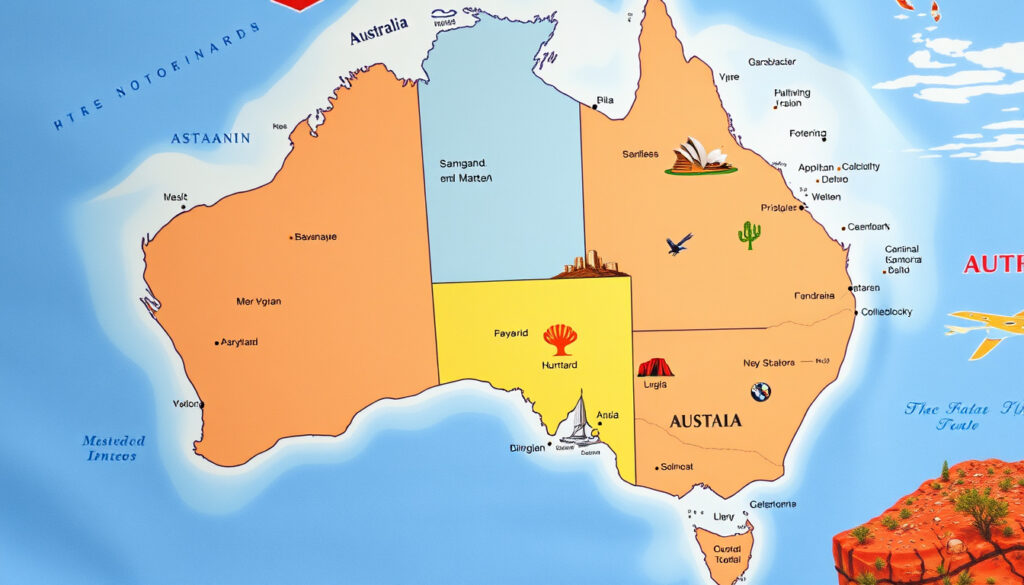
How Many States in Australia? 6 States, Territories Explained
Australia has six federated states — no more, no less — yet the country trips up people who assume the Australian Capital Territory or Northern Territory count as additional states. The confusion matters because constitutionally, states and territories operate under different rules that affect governance, representation, and even economic comparisons.
Number of states: 6 ·
Main territories: 2 (ACT, NT) ·
Total capital cities: 8 ·
Federated states: New South Wales, Queensland, South Australia, Tasmania, Victoria, Western Australia ·
Internal territories: Australian Capital Territory, Northern Territory
Quick snapshot
- Australia has exactly six states since federation in 1901 (Wikipedia – States and territories of Australia)
- The three internal territories are ACT, Jervis Bay Territory, and Northern Territory (Wikipedia – States and territories of Australia)
- There are seven external territories including Christmas Island and Norfolk Island (Wikipedia – States and territories of Australia)
- Whether ACT or NT will pursue statehood in the near future remains uncertain
- Exact admission dates for most states beyond Western Australia are not uniformly documented
- Population data across all territories lacks comprehensive recent updates
- 1908: Canberra-Yass district chosen as national capital site (Geoscience Australia – Area of Australia States and Territories)
- 1911: ACT established as 2,358 sq km federal territory (Geoscience Australia – Area of Australia States and Territories)
- 1913: Canberra officially became the capital city (Wikipedia – List of Australian capital cities)
- NT held a statehood referendum in 1998 that failed — future bids remain possible
- ACT has not held a formal statehood referendum but discussions continue
- External territories remain administered directly by the federal government
This key facts table provides official administrative counts and comparative data sourced from government and reference publications.
| Attribute | Value | Source |
|---|---|---|
| States count | 6 | Wikipedia – States and territories of Australia |
| Territories (internal) | 2 | Wikipedia – States and territories of Australia |
| Total territories | 10 | Wikipedia – States and territories of Australia |
| Largest state | Western Australia | Wikipedia – States and territories of Australia |
| Smallest state | Tasmania | Wikipedia – States and territories of Australia |
Are there 6 or 7 states in Australia?
Australia has exactly six states — no more, no less. The confusion around “seven states” usually stems from people miscounting the Australian Capital Territory or Northern Territory as states, but both are legally classified as federal territories under the Australian Constitution.
List of the six states
- New South Wales — Capital: Sydney
- Victoria — Capital: Melbourne
- Queensland — Capital: Brisbane
- South Australia — Capital: Adelaide
- Tasmania — Capital: Hobart
- Western Australia — Capital: Perth
The six states each have their own constitutions and elected governments, whereas territories operate under federal legislation. This constitutional distinction is why counting territories as states fundamentally misunderstands Australia’s administrative structure.
Overview from official sources
All six states were established through British colonization and later joined the federation between 1901 and federation. According to Britannica Kids (educational resource), Western Australia was admitted to the federation in 1900, with the other states following similar timelines (Britannica Kids – States, territories, and capitals of Australia). Each state governs its own constitutional matters, education, healthcare, and transport within its borders.
The distinction matters for everyday life: state governments control driver licensing, police services, and property law, while the federal government handles immigration, defense, and foreign policy. When people ask about “states versus territories,” they’re often really asking about which level of government makes which decisions.
Why are ACT and NT not states?
The Australian Capital Territory and Northern Territory are territories because they were created after federation and remain under direct federal control. States, by contrast, have their own constitutions and were part of the federation from the beginning — or joined it through their own legislative acts.
Legal and constitutional differences
Under Section 122 of the Australian Constitution, the federal parliament can create territories and govern them directly. States operate under their own constitutions, which were either inherited from British colonial arrangements or adopted upon federation. According to Geoscience Australia (government scientific agency), the ACT was formally established in 1911 when the Canberra-Yass district was ceded to the Commonwealth (Geoscience Australia – Area of Australia States and Territories).
Territories have different levels of self-governance: ACT and NT have elected assemblies and chief ministers, but federal laws can override territory legislation. States cannot have their laws overridden by the federal parliament in the same way — this principle of federalism protects states’ constitutional autonomy.
Path to potential statehood
Both ACT and NT could theoretically become states through a process that would require a referendum, federal legislation, and likely negotiations over representation in the Senate. The Northern Territory held such a vote in 1998, but residents rejected statehood. ACT has discussed statehood but never held a formal referendum.
Territory residents have fewer constitutional protections than state residents — federal parliament could theoretically overturn ACT or NT laws entirely. For Australian citizens living in these regions, statehood would mean stronger self-governance and constitutional safeguards.
Why is the Northern Territory not considered a State in Australia?
The Northern Territory remains a territory rather than a state primarily because of the 1998 referendum outcome, where a majority of NT residents voted against achieving statehood. The Territory government continues to operate under federal legislation rather than its own constitution.
Historical context
The Northern Territory was originally part of South Australia before being separated in 1911. Unlike the six original colonies that became states, the NT never developed the constitutional foundations of self-governance that define statehood in Australia. Jervis Bay Territory was also formed in 1915 when New South Wales ceded land to the Commonwealth to provide the new capital with port access (Geoscience Australia – Area of Australia States and Territories).
Current governance status
Today, the NT has an elected assembly and chief minister, but federal laws take precedence. The Australian government appoints an Administrator to represent the federal executive in the Territory. Until NT residents vote to change this arrangement — or federal parliament decides otherwise — the NT will remain a territory.
The pattern here is consistent: territories exist because they were carved out of existing states or created from unclaimed federal land. They lack the historical constitutional foundation that makes states distinct entities within the federation.
How many states in Australia and their capitals?
Six states means six state capitals, plus two territory capitals, for a total of eight capital cities across Australia. Each capital functions as the seat of government for its respective state or territory.
States and capitals list
The six states and their capitals are well-established administrative centers with distinct populations and economic profiles. Wikipedia documents that all eight capital cities serve as seats of government, with populations ranging from Sydney’s 5,029,768 residents down to Hobart’s 224,462 (Wikipedia – List of Australian capital cities).
- Sydney (New South Wales) — Sydney represents 64.82% of the state’s total population (Wikipedia – List of Australian capital cities)
- Melbourne (Victoria) — Melbourne represents 76.47% of Victoria’s population (Wikipedia – List of Australian capital cities)
- Brisbane (Queensland) — Brisbane represents 48.68% of Queensland’s population (Wikipedia – List of Australian capital cities)
- Adelaide (South Australia) — Adelaide represents 77.31% of South Australia’s population (Wikipedia – List of Australian capital cities)
- Hobart (Tasmania) — Hobart represents 43.37% of Tasmania’s population (Wikipedia – List of Australian capital cities)
- Perth (Western Australia) — Perth represents 79.02% of Western Australia’s population (Wikipedia – List of Australian capital cities)
Territories and capitals
- Canberra (Australian Capital Territory) — Population 403,468; represents 100% of ACT’s population (Wikipedia – List of Australian capital cities)
- Darwin (Northern Territory) — Population 145,916; represents 59.38% of the NT’s population (Wikipedia – List of Australian capital cities)
Canberra is unique among all capital cities — it’s the only one that represents 100% of its jurisdiction’s population, since ACT consists essentially of the city itself. Darwin, by contrast, concentrates less than 60% of the Territory’s residents, reflecting the NT’s dispersed population across vast distances.
Which state is richest in Australia?
Economic comparisons between Australian states reveal significant disparities, with Western Australia often emerging as the wealthiest by GDP per capita due to its mining and resources sector. However, different metrics yield different answers — total GDP, per capita income, and median wages tell different stories about which state truly leads.
Metrics for wealth
Standard economic measurements include gross state product (GSP), GDP per capita, average weekly earnings, and median household income. The Australian Bureau of Statistics publishes comprehensive data on these metrics, but individual sources like Britannica Kids also track state-level economic indicators (Britannica Kids – States, territories, and capitals of Australia).
Top state by income data
Western Australia has historically led in GDP per capita, driven by iron ore, gold, and liquefied natural gas exports from the Pilbara region. Sydney and Melbourne compete for second place, with their financial services, technology, and professional services sectors driving economic output. Queensland and South Australia have lower average incomes but also lower costs of living, making direct comparisons complex.
Western Australia’s mining boom has been volatile — commodity prices fluctuate, and resource-dependent economies face cyclical downturns. Readers comparing state wealth should look beyond headline GDP figures to employment diversity, housing affordability, and median income distributions for a more complete picture.
What we know vs. what remains uncertain
Confirmed facts
- Australia has exactly six states since federation in 1901
- There are ten federal territories total: three internal and seven external
- ACT was established in 1911, spanning 2,358 square kilometres
- The national capital Canberra was officially established in 1913
- Perth represents 79.02% of Western Australia’s population
Uncertain or contested
- Whether ACT or NT will pursue future statehood referendums
- Exact federation admission dates for states other than Western Australia (1900)
- How external territories are governed and administered
- Whether Tasmania qualifies as a separate “island nation” in some contexts
Expert perspectives
Australia’s federal structure is unusual globally — we have states with their own constitutions alongside federal territories administered directly from Canberra. This creates a two-tier system where territories have less autonomy than states, a distinction that surprises many newcomers to Australian politics.
— Academic analysis from Students of History (educational resource)
The Canberra-Yass district was chosen in 1908 specifically to resolve the rivalry between Sydney and Melbourne over which city should host the national capital. This compromise — creating a new city in federal territory rather than situating the capital in either major city — remains unique among national capitals worldwide.
— Geoscience Australia (government scientific agency)
The pattern of capital city concentration also reveals something about Australian urbanization: every state capital except Brisbane houses more than 48% of its state’s population. Melbourne’s dominance in Victoria (76.47%) and Perth’s dominance in Western Australia (79.02%) show how heavily Australians have concentrated in urban centers, particularly coastal capitals.
Related reading: Australian States vs Territories · List of Australian capital cities
mapsofindia.com, emigrate-to-australia.co.uk, studentsofhistory.com, en.wikipedia.org, australia.com
Australia’s six states reveal stark economic contrasts, particularly in average incomes across states among full-time workers reaching about A$100,000 annually.
Frequently asked questions
How many territories in Australia?
Australia has ten federal territories total: three internal territories (Australian Capital Territory, Jervis Bay Territory, and Northern Territory) and seven external territories including Christmas Island, Cocos (Keeling) Islands, and Norfolk Island.
What are the 14 states in Australia?
There are no 14 states in Australia — this number likely comes from confusion between states and either territories or historical regions. Australia has six states and ten territories. Some people may count the external territories as separate regions, but none of them are states.
Smallest state in Australia?
Tasmania is Australia’s smallest state by both area and population. It’s an island state located south of the mainland, with Hobart (population 224,462) as its capital city.
What is the poorest state in Australia?
Economic rankings vary by metric, but Tasmania typically ranks lowest among states by GDP per capita and average weekly earnings. However, Tasmania also has a lower cost of living, so disposable income comparisons yield a more nuanced picture.
How many states in Australia 2020?
Australia had — and still has — six states in 2020. The state’s count has remained constant since federation in 1901. No states have been added, removed, or converted since that time.
Does Australia have six countries?
No, Australia is one country with six states and ten territories. Some people confuse “states” with independent countries, but Australian states are administrative divisions within a single sovereign nation, similar to states in the United States or Canada.
More related posts
 Living Room Decor Ideas: 3-5-7 Rule & 2026 Trends
 Rainbows End Pirate Ship: New Pacifica Ride Opens 2025
 Why Do We Celebrate Matariki – Meaning, History and Traditions
 The Strange Thing About the Johnsons: Where to Watch & More
 Lloyd Elsmore Park Pool & Leisure Centre: Prices, Rules & History
 On The Point Rotorua: Luxury Lakeside Lodge Travel Guide
 How to Choose a Dehumidifier: 12L vs 20L Size Guide
 Early Stage Chicken Pox: Symptoms, Day 1, and Rash Progression