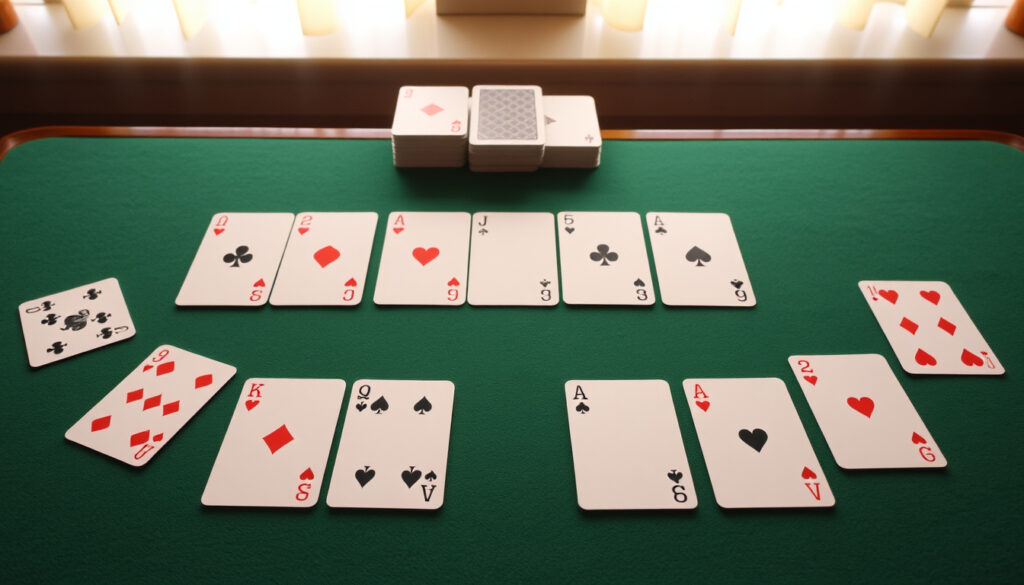
How to Play Solitaire: Step-by-Step Rules & Setup
Solitaire has survived generations as the rare card game that rewards both patience and strategy. The rules take minutes to learn, but beating Klondike — the most popular single-player variant — requires uncovering hidden cards, building foundations carefully, and knowing when to draw from the stock pile.
Standard Deck: 52 cards · Tableau Piles: 7 columns · Foundation Piles: 4 suits (Ace to King) · Stock Draws: 3 cards at a time (Klondike) · Goal: Build all suits in ascending order
Quick snapshot
- Klondike uses a standard 52-card deck without Jokers (Wikipedia)
- Tableau totals 28 cards across 7 columns (The Solitaire)
- Foundations build from Ace to King by suit (Wikipedia)
- Exact win rates vary by player skill level
- Some regional rule variations exist beyond Nine Across
- Klondike remains the most played single-player card game variant in the modern era (Solitaire Bliss)
- Variants like one-handed and double Solitaire offer different challenges
- Digital apps follow Klondike rules with various UI implementations
The game attributes below come from verified rule sources including Wikipedia and leading Solitaire rule guides.
| Attribute | Value |
|---|---|
| Game Type | Klondike (most common) |
| Players | 1 (standard) |
| Deck | 52 standard cards |
| Difficulty | Beginner-friendly |
| Win Rate | ~30% with good play |
How do you play Solitaire step by step?
The core gameplay loop is straightforward: move cards around the tableau, build up the foundations, and flip face-down cards to reveal new options. Each move should serve one of two goals — either getting closer to winning by building foundations, or uncovering hidden cards that unlock more moves.
Deal the cards
Starting from left to right, deal the first card face up to create the start of the first pile. Then deal one face-down card on top of it, followed by one face-up card, and continue in this pattern until all seven columns are built — the first column has 1 card, the second has 2, and so on, ending with 7 cards in the seventh column (Solitaire Bliss). The remaining 24 cards form your draw pile.
Build the tableau
Within the tableau, you can place a card on top of another when it ranks one lower and is the opposite color — a red 6 goes on a black 7, for example (Solitaire Bliss). You can move single cards or stacks of cards as long as they maintain descending order with alternating colors. When a face-down card becomes the top of a column, flip it face up — that new card then becomes available for play.
Move to foundations
As soon as an Ace appears, send it to the foundation — that’s where each suit’s build starts (Solitaire Bliss). From there, stack each foundation in ascending order by suit until a King sits on top. The player wins when all 52 cards are successfully sorted into the four foundation piles (247 Solitaire).
Use the stock pile
When you can’t make any more tableau moves, flip three cards from the stock to the waste pile — the top card of the waste is always playable (247 Solitaire). If you can’t play that card either, all three must remain in the waste. Keep drawing three at a time until the stock is empty, then shuffle the waste back into the stock for another pass.
How to set up a single game of Solitaire?
Setting up a proper game takes about 30 seconds once you know the routine. Get it right from the start and you’ll save yourself confusion later.
Choose a standard deck
Grab a standard 52-card deck and shuffle thoroughly. You won’t need jokers — Klondike doesn’t use them (Wikipedia). The deck needs to be well-shuffled because the initial deal determines everything about your game.
Arrange the tableau
Deal cards one at a time, left to right, face down. Start the first pile with one card, then add one more face-down card to the second pile — continue this until the seventh pile has six face-down cards. Then, going back to the first pile, flip the top card face up. Repeat for each pile until every column has the right count: pile 1 gets 1 card, pile 2 gets 2, and so on through pile 7, which gets 7 cards (The Solitaire).
Prepare stock and waste
Collect all the undealt cards and place them face down in a stack — this is your stock pile. Leave space next to it for the waste pile, where you’ll flip cards during play. The stock goes on the left and waste on the right, or vice versa depending on your preference.
What this means: a well-shuffled deck and correctly arranged tableau prevent frustrating mid-game discoveries that a deal was set up wrong.
How is classic Solitaire played?
Classic Klondike has a few non-negotiable rules that separate valid moves from invalid ones. These aren’t suggestions — break them and the game stops making sense.
Tableau movement rules
Tableau rules are strict: cards must alternate colors and descend in rank. A black 10 can receive a red 9, which can receive a black 8, and so on. When you move a stack, the entire stack must stay in order — you can’t rearrange cards within a stack mid-move. An empty tableau column can only receive a King or a stack that starts with a King (YouTube Tutorial). This single rule shapes most of your strategic decisions.
Stock and waste rules
The classic Klondike variation draws three cards at a time from the stock to the waste pile, cycling through the deck with no limit on passes (247 Solitaire). Some players prefer the 1-card variation, which is easier because you see more of the deck and waste options are simpler.
Foundation building
Foundations start with Aces only — no other rank can begin a foundation pile. Once started, each foundation grows by suit: a 2 of Hearts goes on the Ace of Hearts, then the 3, then the 4, up to the King (Wikipedia). The moment all four foundations each have a King on top, you win.
Moving a card too early to the foundation can sometimes block necessary tableau moves — experienced players often delay foundation moves until they’re certain the card won’t be needed elsewhere (The Solitaire).
The catch: rushing Aces to the foundation feels productive but can trap valuable sequencing cards, reducing your total available moves.
How to play basic Solitaire for beginners?
If you’re new to the game, the rules make sense but the strategy doesn’t — yet. A few concrete tips will get you further than any amount of luck.
Common mistakes to avoid
New players often rush Aces to the foundation before checking whether they’ll need that card to unlock a stuck column. They also tend to leave face-down cards buried under large stacks, never flipping them over. Another common error: playing cards randomly instead of planning two or three moves ahead.
Winning strategies
The first move should be to look over the tableau and move any visible Aces to the foundation immediately — this clears space and gives you options (Solitaire Bliss). Try to build foundations equally rather than focusing on one suit, because you might need cards of a different color later. A good strategy for newer players is to try and build the foundations equally — focusing too much on one suit can backfire if you end up needing certain cards elsewhere (247 Solitaire).
Practice tips
Start with the 1-card variant to learn the basics before moving to the classic 3-card draw. Play slowly and think two moves ahead — speed comes with practice, but bad habits are hard to unlearn. If you’re playing digitally, most apps let you undo moves, which is useful for learning.
The goal in the tableau is to reveal as many face-down cards as possible by moving cards strategically from tableau piles — every card you flip opens new options and chances to win (Solitaire Bliss).
The pattern: players who systematically flip face-down cards early maintain more options throughout the game than those who focus only on immediate point gains.
How to play Solitaire variants?
Once you’ve mastered classic Klondike, a few variations offer different challenges — some easier, some harder, all worth knowing.
One-handed Solitaire
One-handed Solitaire is designed for solo speed play — the deal is adjusted so one person can play without a partner. The rules otherwise follow Klondike, but the shuffle and layout are optimized for quick rounds. If you want faster games for practice or warm-up, this variant delivers.
Two-player Double Solitaire
Double Solitaire gives two players their own tableau and foundation piles — they race each other to finish first. Each player follows standard Klondike rules independently, and the first to complete all four foundations wins. It’s competitive in a way standard Solitaire never is.
Digital versions on phone or online
Most Solitaire apps and websites follow Klondike rules with slight variations in the interface — some use drag-and-drop, others use tap-to-select. Free options include Google’s built-in Solitaire, and dedicated apps like Solitaire Bliss offer multiple variants in one place. Wikipedia notes that Nine Across is a variant where nine columns of cards are dealt instead of seven in classic Klondike — some digital implementations support this option for players wanting a harder challenge (Wikipedia).
Steps to Play Solitaire
- Step 1 — Shuffle and deal: Take a standard 52-card deck, shuffle well, then deal 7 columns with 1, 2, 3, 4, 5, 6, and 7 cards respectively. Only the top card of each column should be face-up.
- Step 2 — Find Aces: Scan the tableau for any Aces showing — move them immediately to the foundation area to start the four suit piles.
- Step 3 — Build tableau: Place cards on the tableau in descending order, alternating colors. Move stacks together when the bottom card of the stack fits the target.
- Step 4 — Flip face-down cards: Whenever you move a face-up card off a column, flip the next card face-up. Keep revealing hidden cards.
- Step 5 — Draw from stock: When stuck, flip three cards from the stock to the waste pile. Use the top waste card for tableau or foundation moves.
- Step 6 — Recycle stock: When the stock is empty, shuffle the waste back into the stock and continue drawing three at a time.
- Step 7 — Win condition: Build all four foundations from Ace to King by suit. The moment the last King is placed, you win.
What this means: digital variants like Nine Across test your adaptability — the same core rules apply, but the wider tableau demands different sequencing priorities.
Confirmed facts
- Klondike: 3-card draw standard per Wikipedia and rule guides
- Setup: 28 cards in tableau across 7 columns
- Tableau: Only top card face-up per column
- Foundations: Build by suit from Ace to King
- Empty spaces: Only Kings fill empty tableau columns
Unconfirmed or variable
- Exact win rates vary by player skill
- Some regional rule variations exist beyond documented variants
The goal is straightforward: Complete the four foundation piles, starting with the ace and ending with the king for each suit.
— Solitaire Bliss (Solitaire rules and strategy guide)
A good strategy for newer players is to try and build the foundations equally — focusing too much on one suit can backfire if you end up needing certain cards elsewhere.
— 247 Solitaire (Official Solitaire Rules guide)
Solitaire has remained the most popular single-player card game for good reason — the rules are simple enough to learn in minutes, but the strategic depth keeps players coming back for decades. Whether you’re shuffling physical cards at the kitchen table or tapping cards on a phone screen, Klondike offers the same satisfying puzzle. The good news for beginners: most games aren’t unwinnable from the start. With a bit of practice and the habits outlined above — moving Aces early, planning ahead, and keeping columns relatively even — your win rate climbs noticeably. The not-so-good news: some shuffles genuinely are impossible to win, and no amount of skill fixes bad luck. That reality keeps Solitaire humble — it’s a game you play, not a problem you solve once and forget.
Related reading: How to Choose a Dehumidifier: 12L vs 20L Size Guide · What Is the Mode – Statistics Explained for Beginners
Once you’ve set up the classic seven tableau columns, try the more demanding Spider Solitaire rules with ten piles and same-suit sequences for added challenge.
Frequently asked questions
What is the goal of Solitaire?
The goal is to build all four foundation piles from Ace to King by suit, using the tableau and stock piles to expose and organize the cards. The moment all 52 cards are in the foundations, you win.
Can you redeal the stock pile?
Yes. When the stock pile is empty, collect the waste pile, shuffle it, and place it face down as the new stock. You can cycle through the deck this way as many times as needed in standard Klondike.
What happens when no moves are left?
When no valid moves remain — either in the tableau or from the waste pile — draw more cards from the stock. If the stock is also empty and no moves exist, the game is over.
Is Solitaire always winnable?
No. Not every deal is winnable. Some shuffles create an impossible situation from the start, and no amount of skill changes that. With good play, experienced players win roughly 30% of games.
How many cards in each tableau pile?
The seven tableau columns hold 1, 2, 3, 4, 5, 6, and 7 cards respectively — totaling 28 cards. Only the top card of each pile is face-up initially.
Differences between Klondike and other Solitaires?
Klondike is the classic version with 7 tableau columns and 3-card draws. Other variants include Spider (4 suits, 104 cards), Pyramid (stacking cards to remove them), and Golf (moving cards to a discard pile). Each has its own rules and win conditions.
Tips for winning more games?
Move Aces to foundations immediately, plan two to three moves ahead, build foundations equally rather than focusing on one suit, and flip face-down cards early by keeping tableau columns short. Patience and practice beat rushing every time.
More related posts
 Pizza Quattro Formaggi Near Me – Top Local Guide and Tips
 173 cm in Feet: Exact Conversion and Height Context
 Wellington Airport Parking Fees: Rates, Options & Tips to Save
 Lloyd Elsmore Park Pool & Leisure Centre: Prices, Rules & History
 Godzilla vs. Kong: Winner, Watch Order & What’s Next
 Fulham F.C. vs Nottingham Forest Lineups – Predicted XIs, Injuries & Team News
 Partner of a New Zealander Work Visa: Requirements, Cost & Time
 New Plymouth Airport Arrivals – Live Flights & Schedule