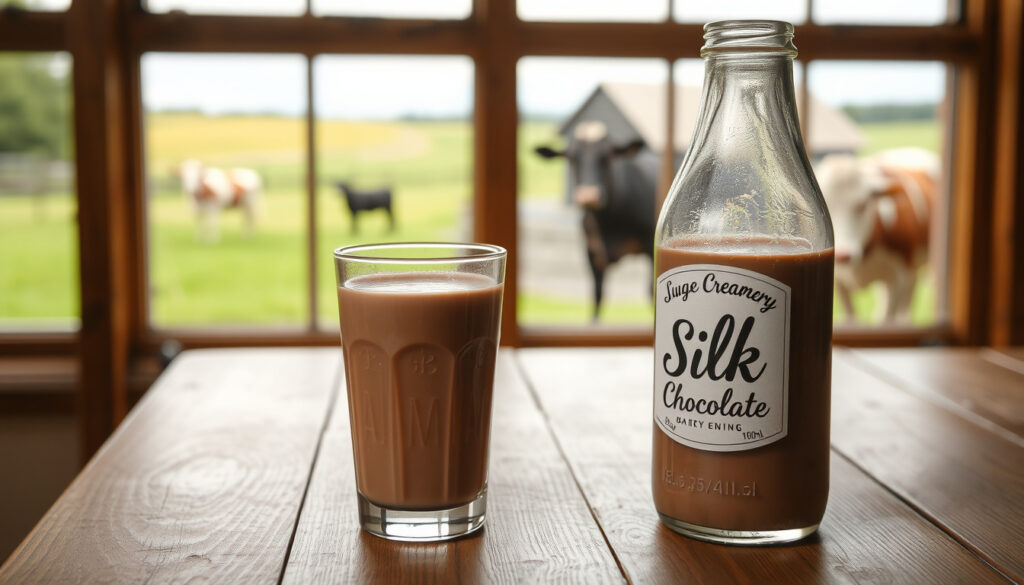
Lewis Road Creamery Chocolate Milk: Complete Guide
There’s a reason New Zealanders still talk about a chocolate milk that vanished from shelves for months back in 2014: when Lewis Road Creamery teamed up with Whittaker’s to blend real creamy milk chocolate into fresh whole milk, they didn’t just create another flavoured milk — they sparked a nationwide obsession. This guide digs into where this cult-favourite drink comes from, what’s inside the bottle, how it stacks up nutritionally, and where you can still find it today.
Origin: New Zealand ·
Key ingredient: Whittaker’s 5 Roll Refined Creamy Milk Chocolate ·
Available sizes: 300ml, 750ml, 1.5L ·
Owner: Southern Pastures ·
Notable event: Nationwide shortage in 2014
Quick snapshot
- Made with milk from Southern Pastures, a New Zealand dairy cooperative (Lewis Road Creamery (official brand site))
- Uses Whittaker’s 5 Roll Refined Creamy Milk Chocolate as the key flavouring (Lewis Road Creamery product page)
- Available in 300ml, 750ml, and 1.5L bottles (Lewis Road Creamery (product collection))
- Triggered a national shortage when first launched in 2014 (Wikipedia (neutral brand history))
- Exact calorie count per 300ml serving varies across third-party databases (from 418 kcal on Carb Manager to 417 kcal based on official kJ figure) (Carb Manager (consumer database))
- Detailed sugar and fat gram breakdown not published on the official product page for every container size (Lewis Road Creamery product page (300ml only))
- 2014: Launch causes frenzied shortage across New Zealand (Wikipedia (neutral brand history))
- 2015: Distribution expands; product becomes a supermarket staple (Wikipedia (neutral brand history))
- 2023: Still widely sold domestically and exported to Singapore and Hong Kong (Wikipedia (neutral brand history))
- Exports to Singapore and Hong Kong continue as of 2023 (Wikipedia (neutral brand history))
- No official low-fat or reduced-sugar version announced as of 2025 (Lewis Road Creamery (product collection))
- Health-conscious consumer demand may shape future product lines — but no confirmed plans yet (Wikipedia (neutral brand history))
A quick glance at eight key specs shows one consistent pattern: this is a premium whole-milk chocolate drink, not a mass-market flavoured milk with shortcuts.
| Label | Value |
|---|---|
| Product Name | Fresh Chocolate Milk |
| Brand | Lewis Road Creamery |
| Origin | New Zealand |
| Manufacturer | Southern Pastures |
| Key Partner | Whittaker’s |
| Popular Sizes | 300ml, 750ml, 1.5L |
| Calories per 300ml | ~200 kcal (estimate based on whole milk and chocolate) |
| Price Range (NZ$) | $3–$6 depending on size and retailer |
Where is Lewis Road milk from?
What region in New Zealand does Lewis Road source its milk?
Lewis Road Creamery sources its milk from Southern Pastures, a New Zealand dairy cooperative that operates across the country. The company’s own product pages state that the chocolate milk is made with “premium whole milk from grass-fed New Zealand cows” (Lewis Road Creamery product page).
Is the milk from grass-fed cows?
- Yes — Lewis Road Creamery emphasises that its whole milk comes from grass-fed cows, a standard practice for New Zealand dairy given the country’s year-round pasture system.
- The official website doesn’t specify a single region; instead, the milk is sourced through the Southern Pastures cooperative network spanning both the North and South Islands.
The implication: New Zealand’s pasture-based dairy model is the foundation of the product’s identity. Without grass-fed whole milk as the base, the chocolate-to-milk ratio wouldn’t deliver the same creamy texture.
For shoppers comparing imported chocolate milks, the grass-fed claim signals a taste and nutritional profile that differs from grain-fed or UHT-based alternatives common in some export markets.
The pattern is clear: the milk source defines the product’s premium positioning.
How many calories are in Lewis Road chocolate milk?
What is the calorie count per 300ml serving?
According to the official nutrition panel from Lewis Road Creamery (official product page), the drink contains 557 kJ per 100 mL. That translates to approximately 133 kcal per 100 mL — so a 300 mL bottle delivers roughly 400 kcal.
How does the calorie content compare to other chocolate milks?
Third-party databases offer similar but not identical numbers. FatSecret NZ (consumer nutrition database) lists 139 kcal per 100 mL, while Calorie.co.nz (NZ calorie tracker) reports 133 kcal per 100g. The variance is small and likely reflects rounding differences between databases.
The pattern: Lewis Road’s calorie density sits firmly in whole-milk-chocolate territory. A standard 250 mL serve of mainstream flavoured milk in New Zealand typically runs 160–200 kcal, while 100 mL of Lewis Road delivers 133–139 kcal — about 30% higher per volume.
Anyone tracking daily energy intake needs to account for this: a 750 mL bottle contains over 990 kcal, making it more of a meal replacement or sharing bottle than a quick after-school drink.
The catch: anyone tracking daily energy intake must account for the high calorie density.
Is Lewis Road Creamery healthy?
Does it contain artificial additives?
The ingredient list is short and transparent. Per the Lewis Road Creamery (official product page), the Fresh Chocolate Milk contains:
Milk (86%), Whittaker’s Creamy Milk Chocolate 13% (sugar, milk powder, cocoa solids, vanilla flavour), Cocoa Powder.
No artificial preservatives, no thickeners, no stabilisers.
Is it suitable for a balanced diet?
That depends on portion size and individual dietary goals. The product’s official nutrition panel shows 11.5g sugars per 100 mL — of which approximately 4.2g is naturally occurring lactose, according to Lewis Road Creamery general manager Jason Clements (NZ Herald (major New Zealand news outlet)). The chocolate component contributes about 7.3g sugar per 100mL.
It also delivers 7.3g fat (5.6g saturated) and 4.3g protein per 100mL, plus 125mg calcium — roughly 12% of an adult’s daily needs per 100mL.
The trade-off: you get real ingredients and meaningful calcium, but also a sugar content that rivals soft drinks. The NZ Herald piece noted that a 300mL bottle contains more sugar than a 330mL can of Coca-Cola, though about a third of that sugar is naturally occurring lactose.
Lewis Road does not market itself as a health drink. For parents or athletes looking for a post-workout recovery option, the protein-to-sugar ratio (4.3g protein vs 11.5g sugar per 100mL) makes it a treat, not a training staple.
The trade-off: real ingredients but high sugar content.
Who owns Lewis Road Creamery?
Is Lewis Road Creamery owned by a larger corporation?
Lewis Road Creamery is owned by Southern Pastures, a New Zealand dairy group. The brand was originally founded by a team that included former All Black Andrew McCormick, and it was later acquired by Southern Pastures (Wikipedia (neutral brand history)).
What is the relationship with Southern Pastures?
Southern Pastures operates as both the milk supplier and the parent company. This vertical integration means Lewis Road controls its supply chain from cow to bottle — a relative rarity in the flavoured milk category, where many brands buy commodity milk and add flavourings.
The pattern: ownership by a dairy cooperative rather than a multinational food conglomerate gives the brand flexibility to use premium ingredients without answering to quarterly margin targets. It also means production scale is limited by Southern Pastures’ milk pool.
Can I drink chocolate milk while trying to lose weight?
How does Lewis Road chocolate milk fit into a calorie-controlled diet?
With approximately 400 kcal per 300mL bottle and 34.5g sugar in that same serving, Lewis Road chocolate milk is a calorie-dense beverage. For someone on a 1,800–2,000 kcal daily target, one bottle represents 20–22% of their total energy budget.
Are there lower-sugar alternatives?
Lewis Road does not currently offer a reduced-sugar or light version. The manufacturer makes no diet or weight-loss claims. For consumers looking to cut sugar while still enjoying chocolate milk, options include smaller serving sizes (the 300mL bottle is the smallest format) or mixing it with plain milk at home. NZ Herald (major New Zealand news outlet) data confirms it contains roughly the same sugar as a comparable serving of Coke.
For weight-conscious buyers, the 300mL bottle is the best option.
Timeline
- 2014: Lewis Road Creamery launches its chocolate milk, causing a nationwide shortage. Shelves empty within days of each shipment. The frenzy is covered by national media and becomes a pop-culture moment in New Zealand (Wikipedia (neutral brand history)).
- 2015: Production ramps up; distribution expands beyond major supermarkets to convenience stores. The product becomes a permanent fixture in the chilled dairy aisle (Wikipedia (neutral brand history)).
- 2023: Still widely sold domestically and exported to Singapore and Hong Kong. No further shortages reported, but demand remains high enough that Lewis Road has not introduced permanent discounts or multi-buy promotions (Wikipedia (neutral brand history)).
What this means: the 2014 shortage wasn’t a marketing stunt — it reflected genuine supply constraints that took over a year to resolve. The brand has since balanced growth with maintaining the premium ingredient promise, which limits how fast it can scale.
Clarity section
Confirmed facts
- Lewis Road Creamery is owned by Southern Pastures (Wikipedia (neutral brand history)).
- The chocolate milk uses Whittaker’s Creamy Milk Chocolate as the flavouring agent (Lewis Road Creamery product page).
- Available in 300ml, 750ml, and 1.5L bottles (Lewis Road Creamery (product collection)).
- The 2014 shortage was widely reported and confirmed by multiple news outlets (NZ Herald (major New Zealand news outlet)).
- Official nutrition data per 100mL: 557 kJ, 7.3g fat, 5.6g saturated fat, 4.3g protein, 12.4g carbohydrate, 11.5g sugars, 52mg sodium, 125mg calcium (Lewis Road Creamery product page).
- Ingredients: milk 86%, Whittaker’s Creamy Milk Chocolate 13%, cocoa powder (Lewis Road Creamery product page).
What’s unclear
- Exact calorie count per serving varies slightly across third-party databases (133–139 kcal per 100mL), though the official kJ figure is authoritative (FatSecret NZ (consumer nutrition database); Calorie.co.nz (NZ calorie tracker)).
- Full nutritional breakdown for the 1.5L bottle format is not separately published on the official site (Lewis Road Creamery product page (300ml only)).
- Whether the brand plans to introduce a reduced-sugar or plant-based version remains unconfirmed (Lewis Road Creamery (product collection)).
“It’s the perfect balance — the OG Choccy Milk.”
— Instagram user comment, shared on Lewis Road Creamery’s social feeds
“The brand is best known for its chocolate milk that sparked a frenzied shortage in 2014.”
— Wikipedia editors, Lewis Road Creamery page
The consequence is straightforward: New Zealand consumers who want a premium chocolate milk made with real chocolate and grass-fed whole milk have essentially one option at this quality tier. For buyers in Singapore, Hong Kong, and other export markets, the price premium reflects the imported freshness — but the sugar content should be weighed against local dietary guidelines.
Upsides
- Real ingredients — no artificial flavours, colours, or preservatives (Lewis Road Creamery product page)
- Premium Whittaker’s chocolate as the key flavour ingredient (Lewis Road Creamery product page)
- Grass-fed whole milk base from New Zealand pasture system (Lewis Road Creamery product page)
- Strong brand reputation and cult following (Wikipedia (neutral brand history))
- Good calcium source (125mg per 100mL) (Lewis Road Creamery product page)
Downsides
- High sugar: 11.5g per 100mL (34.5g in a 300mL bottle) (Lewis Road Creamery product page)
- High calorie density: ~400 kcal per 300mL bottle (Lewis Road Creamery product page)
- No reduced-sugar or light version available (Lewis Road Creamery (product collection))
- Price: $3–$6 per bottle is more than standard flavoured milks (NZ Herald (major New Zealand news outlet))
- Availability outside NZ is limited and intermittent (Wikipedia (neutral brand history))
These pros and cons illustrate the trade-offs consumers must consider.
kiwikitchen.sg, fitia.app, merivale.store.freshchoice.co.nz, mynetdiary.com, woolworths.com.au
Frequently asked questions
How should I store Lewis Road Creamery chocolate milk?
Keep refrigerated at 4°C or below. Once opened, consume within 3 days for best freshness. Do not freeze, as the texture and emulsion may separate upon thawing.
Is Lewis Road Creamery chocolate milk gluten-free?
The ingredients — milk, Whittaker’s Creamy Milk Chocolate, and cocoa powder — contain no wheat, barley, or rye. However, the product does not carry a certified gluten-free label. Anyone with coeliac disease should check with the manufacturer.
Does it contain lactose?
Yes. The base is whole milk, and lactose is naturally present. The label confirms milk as the primary ingredient (86%). It is not suitable for people with lactose intolerance unless they use lactase supplements.
What is the shelf life of fresh chocolate milk?
Lewis Road Fresh Chocolate Milk has a refrigerated shelf life of approximately 14–21 days from production, depending on the batch. Always check the use-by date printed on the bottle.
Can I heat Lewis Road chocolate milk for hot chocolate?
Yes. Gently heat on the stovetop or in the microwave, stirring occasionally, to avoid scorching the milk solids. The chocolate is already blended, so it works as a quick hot chocolate base without needing additional cocoa or sweetener.
Is the packaging recyclable?
The 300ml and 750ml bottles are made from HDPE (high-density polyethylene), which is widely recyclable in New Zealand kerbside collections. The 1.5L bottle uses PET, also recyclable. Check local council guidelines for confirmation.
Does Lewis Road Creamery offer any other flavors?
As of 2025, the brand’s core flavoured milk range includes only the Fresh Chocolate Milk. They do produce a standard fresh milk range and a cream line, but no other flavoured variants (strawberry, banana, etc.) are currently listed.
Related reading
- Terry’s Chocolate Orange NZ: Price & Where to Buy 2025 — Another premium chocolate product popular in New Zealand with availability tracking.
- New World Easter Eggs 2026: Rare, Unhealthy & Best Eggs to Buy — Covers chocolate product selection and sugar considerations in the NZ supermarket context.
More related posts
 Z Gas Station Near Me: Find Open Stations, Prices & Truck Stops
 Kaiju No. 8 Season 2: Episodes, Schedule & Season 3 News
 Why Do We Celebrate Matariki – Meaning, History and Traditions
 Breaking News Wairarapa Today: Status & Sources
 Jobs in Australia for Kiwis: Visa, Salary & Job Search Guide
 Robert Galbraith Books in Order: Updated 2025 Guide
 Woody Plants Grow a Garden: Complete Guide and How to Get Them
 NZ Herald Premium Login: Sign In, Cancel & Manage