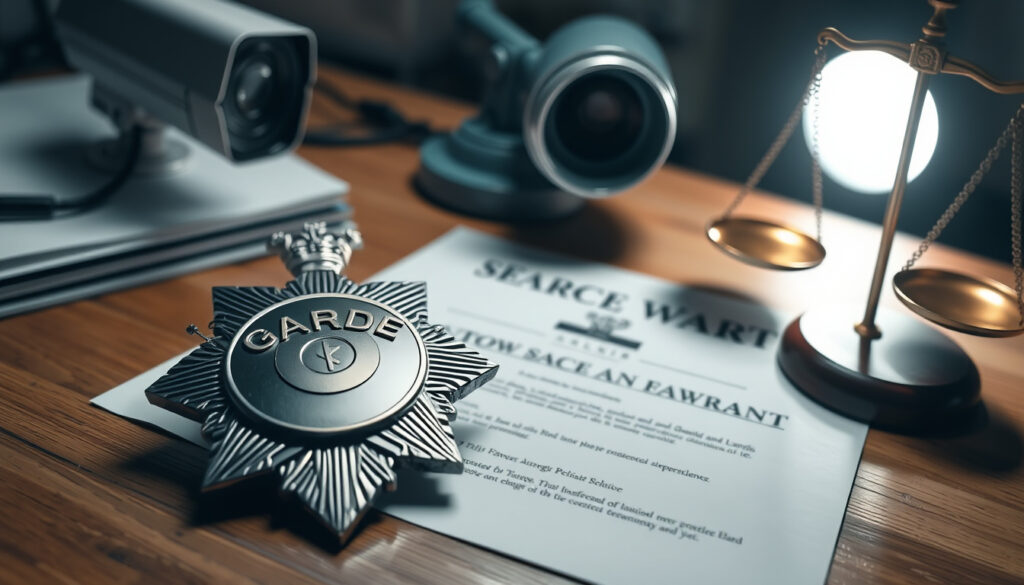
Search and Surveillance Act: Garda Powers and Rights Explained
If you’ve ever wondered exactly what a Garda can and cannot do when they stop you on the street, search your car, or ask questions at your front door, you’re not alone. The rules around police powers can feel murky, even when they are written down in black and white. This guide walks through the main law that governs surveillance by Garda Síochána, what it means for your day-to-day rights, and where the limits actually sit.
Primary Act: Criminal Justice (Surveillance) Act 2009 · Key Section: Section 14 · Recent Update: Garda Síochána (Recording Devices) Act 2023 · Official Source: Irish Statute Book · Rights Guide: Citizens Information
Quick snapshot
- The Act was enacted on 12 July 2009, applying to Garda Síochána, Defence Forces, Revenue Commissioners, and other bodies (Law Reform Commission)
- Section 4 requires a District Court judge to authorise most surveillance operations (Law Reform Commission)
- Section 7 allows a Garda Superintendent to approve urgent surveillance for up to 72 hours without prior judicial sign-off (Law Reform Commission)
- Exact application of common law powers to stop and search in situations not explicitly covered by statute
- How Section 14’s admissibility provisions interact with novel surveillance technologies not contemplated in 2009
- Act passed: 12 July 2009 (Law Reform Commission)
- Procedural rules (SI No. 314/2010) issued in 2010 (Courts.ie)
- Records excluded from FOI Act 2014 on 14 October 2014 (Law Reform Commission)
- Annual oversight reports available for 2010–2016 (Digital Rights Ireland)
- The 2023 Recording Devices Act introduces updated rules on police use of body cameras and dashcams
- Ongoing court cases continue to test the boundaries of Section 14 admissibility
- Civil liberties groups are watching whether oversight mechanisms remain adequate
| Fact | Detail |
|---|---|
| Main Legislation | Criminal Justice (Surveillance) Act 2009 |
| Publisher | Law Reform Commission (official revised text) |
| Surveillance Rule | Judicial authorisation from a District Court judge is required in most cases |
| Questioning | Co-operation with Garda questioning is requested rather than always compelled (Citizens Information) |
| Section 14 Focus | Authorisation by judge; evidence remains admissible even if minor procedural errors occur |
What is the search and surveillance act?
The Criminal Justice (Surveillance) Act 2009 is the primary statute that puts rules around covert and directed surveillance by Irish law enforcement. It covers surveillance by Garda Síochána, the Defence Forces, Revenue Commissioners, and authorised officers of bodies such as the Competition and Consumer Protection Commission. The Act was enacted on 12 July 2009, filling a gap where covert surveillance had previously been carried out without a clear statutory basis.
According to the Law Reform Commission’s revised text, the Act does not render otherwise lawful activities unlawful. It simply sets the conditions under which state agencies can use surveillance devices, enter premises to install or remove equipment, or track individuals or vehicles. The Act also amends the Garda Síochána Act 2005, integrating surveillance oversight into broader police governance.
Criminal Justice (Surveillance) Act 2009 overview
The core mechanism is authorisation. Under Section 4, a superior Garda officer must apply to a District Court judge if there are reasonable grounds for believing surveillance is necessary to investigate an arrestable offence. The judge must be satisfied that the surveillance is proportionate and that less intrusive means have been considered or would not work.
Surveillance authorisations under the Act can permit entry to private premises to install or remove surveillance devices. Audio and video surveillance with judicial approval can run for up to three months, while tracking devices placed on vehicles require only superior officer approval and can last up to four months with no judicial permission needed (The Journal).
The implication is that tracking vehicles is treated as less intrusive than audio or video surveillance, which explains the different approval thresholds.
Related legislation
Two other statutes interact with the 2009 Act. The Interception of Postal Packets and Telecommunications Messages (Regulation) Act 1993 covers phone taps and mail interception, operating alongside rather than replacing the surveillance Act. The Garda Síochána (Recording Devices) Act 2023 is the most recent addition, updating rules for body-worn cameras and dashboard cameras used by Gardaí on patrol.
The 2009 Act is primarily about covert surveillance — wiretaps, tracking devices, premises entry for installation. Ordinary street-level stop and search falls under different rules, which the Act does not displace. What this means is that the Act gives Gardaí significant covert powers, but those powers do not extend to everyday police encounters on the street.
Are Garda allowed to stop and search?
Yes, but the power is not unlimited. Gardaí have stop powers under the Criminal Justice Act 2006, which allows an officer to stop a person if there are reasonable grounds to suspect they are committing, have committed, or are about to commit an offence. This is sometimes called the “reasonable suspicion” standard — it is not a blank cheque.
The Citizens Information service explains that a Garda can request a person to stop, and if the person refuses, the Garda can use reasonable force to effect the stop. For vehicle stops, the same reasonable suspicion test applies — a Garda cannot pull someone over simply because they feel like it.
Stop powers
Stop powers under the 2006 Act do not require the same judicial authorisation process as covert surveillance under the 2009 Act. Instead, the officer on the street makes the judgment. If challenged in court, the prosecution must show the officer had objectively reasonable grounds for the stop, not merely a hunch.
What this means is that stop-and-search decisions are subject to post-hoc judicial scrutiny, but they do not require prior approval.
Search conditions
A search of a person’s outer clothing or bag can occur after a lawful stop if the officer believes the person is carrying contraband, stolen goods, or something that could be used in an offence. A full search involving removal of clothing generally requires more specific authorisation. Search of a vehicle may involve the passenger compartment or boot depending on the circumstances and what the officer suspects is inside.
Common law powers
Outside the statute, common law gives Gardaí some powers to search a person in specific situations — for example, if they are arresting someone, they can search for weapons or evidence relevant to the arrest. The exact boundary between statutory and common law powers is where things become genuinely unclear, and courts have addressed this on a case-by-case basis.
The express terms of the 2009 Act seek to confine surveillance to specified activities carried out “by or with the assistance of surveillance devices.”
MacMenamin J. — Criminal Justice in Ireland legal analysis
Can you refuse to give your name to a Garda?
This is one of the most commonly asked questions, and the honest answer is: it depends on the situation. According to Citizens Information, Gardaí are entitled to request your co-operation when investigating a criminal offence. They are not necessarily entitled to compel you to answer in every circumstance, but they can request that you accompany them to a station if they have reasonable grounds.
If a Garda asks for your name and address on the street and you are not suspected of any offence, you may decline. However, if you are suspected of an offence, or if the officer has reasonable grounds to believe you are required to provide this information under other legislation, refusal could amount to obstruction.
Legal obligations during questioning
The key distinction is between request and compulsion. A Garda can request information, and you can generally choose not to answer — but that choice may have consequences depending on what they suspect you of. If you are arrested, the situation changes entirely: you must provide your name, address, and date of birth.
Under Irish law, there is no general statutory requirement for every person to carry identification. This means a Garda cannot automatically demand to see your ID on the street. The Irish Council for Civil Liberties has long advocated that people understand the difference between what is requested and what is legally compelled.
Garda questioning rights
A Garda can question you about an offence, but you have the right to silence in most circumstances. Anything you do say can be noted and potentially used as evidence. The Garda must follow proper procedures during questioning, including administering the cautions required by law.
The catch is that silence itself can sometimes be used against you in court, particularly if you raise a defence later that you did not mention during questioning.
In 2009–2010, emergency authorisations by senior Gardaí totalled double the number approved by judges — showing how significantly the 72-hour urgency provision is used in practice. This suggests that internal approvals are a substantial part of how the surveillance regime operates.
Can you refuse a Garda search?
Generally, no — if a Garda has lawful authority to search you, refusal may constitute obstruction. However, the validity of the search itself depends on whether the officer actually had the required authorisation or reasonable grounds. If you believe a search is unlawful, you can comply under protest, state clearly that you do not consent, and challenge the search later through legal channels.
Warrant requirements
For stop-and-search on the street, no warrant is required — the officer relies on the reasonable suspicion standard from the Criminal Justice Act 2006. For entry to premises or covert surveillance, however, judicial authorisation under the 2009 Act is required. A warrant from a court is different from the authorisation process under the surveillance Act.
Under Section 7, a Garda Superintendent can approve urgent surveillance without prior judicial approval, but this is limited to 72 hours. Within that window, the officer must seek judicial confirmation. The Law Reform Commission’s text specifies that urgent approval requires particulars of the device, subject, and the authorising officer.
The pattern here shows the law creates a fast track for emergencies but requires judges to sign off eventually — a balance between operational flexibility and judicial oversight.
Consent and refusal
If a Garda asks for your consent to a search, you can refuse — but they may then seek another basis to search you. If they have reasonable suspicion already, your refusal does not stop them. The practical point is that consent makes the search smoother; refusal without lawful basis does not prevent it.
The exception is when you are inside your home. A Garda generally cannot enter your home without either your consent, a warrant, or exigent circumstances (an emergency). The question of whether you must answer the door at all is addressed in the FAQ below.
What is Section 14 of the Criminal Justice (Surveillance) Act 2009?
Section 14 is one of the most practically significant provisions in the Act, even though it sounds dry. It says that evidence obtained through surveillance under authorisation or urgent approval remains admissible in criminal proceedings even if there are errors or omissions in the authorisation. The purpose is to prevent technical breaches from automatically sinking a prosecution.
This is important because it means that if a Garda superintendent authorises surveillance and later there is a minor defect in the paperwork, the evidence does not automatically become unusable. Courts have interpreted this provision carefully, as shown in the People (DPP) v Mallon case from 2011, where the Court of Criminal Appeal noted its significance for admissibility.
Authorisation process
Under Section 4, a superior Garda officer applies to a District Court judge. SI No. 314 of 2010 regulates how the District Court handles these applications (Courts.ie). The judge must be satisfied the application is proportionate. The designated judge then provides annual reports to the Taoiseach and the Oireachtas on how surveillance powers are being used.
Section 10 restricts disclosure of authorisations and related documents — meaning much of the detail about who is being surveilled is not public. Records held by Gardaí under the Act are explicitly excluded from the Freedom of Information Act 2014 by section 42(b)(ix) (Law Reform Commission).
What this means is that the public has limited visibility into how often and in what circumstances surveillance is deployed under the Act.
Judicial oversight
A designated judge — separate from the District Court judges who grant individual authorisations — compiles annual reports on covert surveillance use. These reports cover 2010–2016 and are available through Digital Rights Ireland. However, the Taoiseach can remove sensitive sections before the reports reach the Oireachtas.
The Court of Appeal in People (DPP) v R McC in 2017 emphasised strict adherence to authorisation conditions, suggesting courts will not simply defer to police claims of urgency. The message is that Section 14 saves minor defects but does not excuse fundamental departures from the authorisation process.
The implication is that courts take the authorisation process seriously and will not tolerate wholesale circumvention, even if Section 14 provides a safety net for paperwork problems.
What we know vs what remains unclear
Confirmed facts
- Act enacted in 2009, applies to Gardaí, Defence Forces, and Revenue
- Section 14 requires judge approval for authorisations; evidence remains admissible despite minor errors
- Garda can request co-operation for criminal investigations
- Records under the Act are excluded from FOI Act 2014
- Emergency (Section 7) approvals are limited to 72 hours
- Designated judge produces annual oversight reports (2010–2016 on record)
What’s unclear
- Exact application of common law search powers in edge cases not covered by statute
- Whether the 72-hour emergency provision is being used more widely post-2010
- How the 2023 Recording Devices Act interacts with the 2009 Act in practice
- Whether oversight reports have resumed publication after 2016
Garda Síochána are entitled to request the co-operation of any person for the purposes of an investigation into a criminal offence.
Citizens Information official guidance — rights during Garda questioning
Summary
The Criminal Justice (Surveillance) Act 2009 is the framework that governs how Irish state agencies can monitor, track, and record people. Most surveillance requires a District Court judge’s authorisation, with a narrower 72-hour emergency window for urgent cases. Section 14 is the provision that keeps evidence admissible even when paperwork is imperfect — a practical safeguard for prosecutions, but one courts still police closely.
For everyday citizens, the more relevant rules are the stop-and-search powers under the Criminal Justice Act 2006, which require reasonable suspicion but not judicial authorisation, and the questioning rights governed by general criminal procedure. You can generally decline to give your name if you are not suspected of an offence, but you must comply with a lawful search and have the right to silence during questioning.
For those in Ireland who want to understand what Gardaí can actually do, the bottom line is clear: the law gives police real powers, but it also draws lines. Courts will keep testing where those lines sit, and the 2023 Recording Devices Act adds a new layer that case law has not yet settled. The practical takeaway is that citizens should know their rights before any encounter, and challenge any overreach through proper legal channels.
Can a Garda stop you for no reason?
No. A Garda must have reasonable grounds to suspect you are committing, have committed, or are about to commit an offence before stopping you on the street. If you are stopped and believe there were no objective grounds for the stop, this can be raised during any subsequent legal proceedings.
Can Garda search your car?
Yes, if the officer has reasonable grounds to believe the vehicle contains evidence of an offence, contraband, or items that could be used in an offence. The search can cover the passenger compartment and may extend to the boot depending on the circumstances. Unlike covert surveillance under the 2009 Act, vehicle stops do not require judicial authorisation — the officer on the ground makes the call.
Do I legally have to answer the door?
No. A Garda cannot force you to open the door. If they are at your home, they need either your consent, a warrant, or exigent circumstances (such as believing someone inside is in immediate danger) to enter. You are entitled to speak to them through the door or not at all. If they have a warrant, you should verify it before letting them in.
Is it illegal to curse at a Garda?
It is not a criminal offence to swear at a Garda in most circumstances, but it can potentially amount to public order offences such as using threatening, abusive, or insulting behaviour in a public place. The line is drawn at behaviour that causes fear or provocation — simply using profanity without more is generally not prosecuted, but officers have discretion, and context matters.
Can employers watch you on CCTV in Ireland?
Employers can use CCTV in workplaces, but they must comply with data protection law and inform employees that monitoring is taking place. The Workplace Relations Commission and the Data Protection Commission have guidance on this. Covert workplace surveillance by employers is generally prohibited unless exceptional circumstances apply.
Can a cop walk around your property?
A Garda cannot simply walk onto your private property without lawful authority. If your property is not fenced or enclosed, the situation can become ambiguous, but in general a Garda needs either a warrant, your consent, or specific statutory power to enter. Walking around your garden or driveway without one of those bases could be challenged as trespass.
What three elements must be present to prove that an assault occurred?
Under Irish criminal law, assault generally requires: (1) the application of force to or on another person, (2) intentionally or recklessly, (3) without that person’s consent. There are variations — assault occasioning harm carries additional elements — but these three components are the core test for a basic assault charge.
Related reading: Is Easter Sunday a Public Holiday in Ireland? · Mutonhori Wairoa District Council Dispute
More related posts
 Weight Loss Medication NZ: Options, Costs, and Funding Guide
 Packed to the Rafters: Complete Guide to the Beloved Series
 Kennedy Good Bridge Lower Hutt: History, Traffic & Floods
 Rice Rice Baby Hamilton Menu: Dishes, Prices & Reviews
 Book Character Dress Up: Easy Ideas for Kids & Adults
 Mag and Turbo Hamilton: Prices, Reviews and Services
 St Marks Breast Centre – Private Mammogram, Costs & Services
 First Home Buyers NZ: 5% Deposit, Grants & Loans Guide