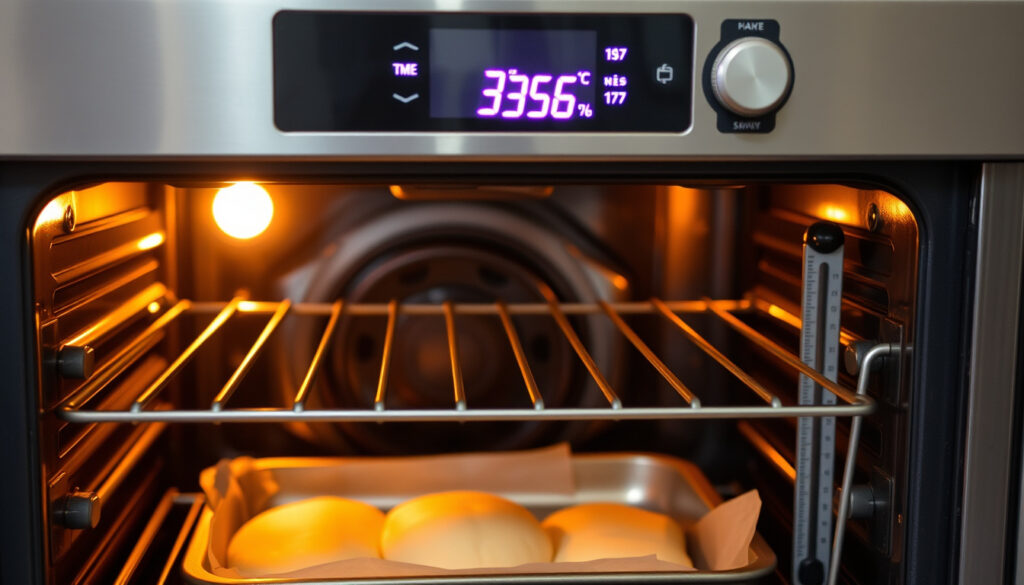
350 Degrees F to C: Oven Temperature Conversion Guide
You are halfway through a cake recipe and the oven temperature is in Fahrenheit while your dial reads Celsius. Converting 350°F — the most common baking temperature in American recipes — is simpler than you might think, and knowing exactly what 350°F equals in Celsius can save your bake from disaster.
350°F in Celsius: 176.67°C ·
Gas mark equivalent: Gas mark 4 ·
Fan oven setting: Approximately 160°C (reduce by 20°C) ·
Common use: Medium-high oven temperature for baking and roasting ·
Formula: °C = (°F – 32) × 5/9
Quick snapshot
- 350°F = 176.67°C (Skint Chef (cooking resource))
- Fan oven equivalent ≈ 160°C (Domestic & General (UK appliance care))
- Gas mark 4 (Which.co.uk (consumer association))
- Exact fan reduction may vary by oven model (Beko UK (kitchen appliance manufacturer))
- Gas mark maximum differs between countries (some ovens go to mark 10) (Domestic & General (UK appliance care))
- 325°F = 163°C / Gas 3 (Flawless Food (recipe blog))
- 375°F = 191°C / Gas 5 (Flawless Food (recipe blog))
- 400°F = 204°C / Gas 6 (Flawless Food (recipe blog))
- Apply conversion to any Fahrenheit recipe (Doves Farm (flour producer))
- Check your oven manual for specific fan adjustments (Beko UK (kitchen appliance manufacturer))
The conversion hinges on a simple formula: subtracting 32 from the Fahrenheit value, then multiplying by 5 and dividing by 9.
| Attribute | Value |
|---|---|
| Exact conversion of 350°F | 176.6667°C |
| Fan oven equivalent | 160°C (reduce by ~20°C) |
| Gas mark | 4 |
| Typical use | Baking cakes, cookies, casseroles |
| Formula | (°F – 32) × 5/9 |
What is 350°F in a fan oven?
Exact conversion formula
- The precise calculation: 350°F – 32 = 318; 318 × 5 = 1590; 1590 ÷ 9 = 176.67°C (Skint Chef (cooking resource)).
- Most recipes round this to 180°C for conventional ovens (Flawless Food (recipe blog)).
Adjusting for fan ovens (reduce by 20°C)
- Fan ovens circulate hot air, cooking more evenly and quickly, so you lower the temperature by about 20°C (Domestic & General (UK appliance care)).
- For 350°F (180°C conventional), set a fan oven to 160°C (Which.co.uk (consumer association)).
The pattern is consistent: subtract 20°C from any conventional temperature to get the fan equivalent.
| Oven type | Temperature setting |
|---|---|
| Conventional (electric/gas) | 180°C |
| Fan / convection | 160°C |
| Gas mark | 4 |
If you have a fan oven, you’re essentially getting 350°F performance at 160°C. That means shorter preheat times and potentially quicker baking — keep an eye on the timer.
Is 350°F the same as 180°C?
Why recipes often round to 180°C
- 350°F equals 176.67°C — close enough to 180°C that most cookbooks round up (Skint Chef (cooking resource)).
- The 3.33°C difference is negligible for most baking, especially for items like cookies and casseroles that are forgiving (Beko UK (kitchen appliance manufacturer)).
Precision vs. practical cooking
- For delicate pastries or meringues, a 4°C offset can affect structure — use the exact 176.67°C if your oven allows digital input (Flawless Food (recipe blog)).
- Broader advice from Doves Farm (flour producer): treat 180°C as the standard equivalent; your oven’s natural variation (±10°Cason) is usually larger than the rounding error.
Impact on baking results
- Using 180°C instead of 176.67°C may shorten bake time by 2–3 minutes for sensitive recipes (Which.co.uk (consumer association)).
- The pattern: for most home baking, the difference won’t ruin your dish — but for high-precision batches (e.g., professional pastry), stick to the exact formula.
Home bakers who blindly use 180°C may over-bake slightly; professionals who insist on 177°C gain consistency across batches. The trade-off is speed vs. precision.
The implication: rounding is fine for everyday recipes, but batch consistency in a commercial kitchen demands precision.
What is 180°C in a fan oven?
Converting 180°C conventional to fan
- 180°C conventional becomes 160°C fan — the same 20°C reduction applies (Domestic & General (UK appliance care)).
- This is consistent across all temperatures: subtract 20°C for fan conversion (Which.co.uk (consumer association)).
Gas mark equivalent
- 180°C conventional / 160°C fan = Gas Mark 4 (Flawless Food (recipe blog)).
- British and Irish gas ovens use the Gas Mark scale: mark 4 is described as “moderate” (Which.co.uk (consumer association)).
Common recipes using 180°C
- Victorian sponge, shortbread, roasted vegetables, most muffin recipes (Doves Farm (flour producer)).
- For fan ovens at 160°C, reduce cooking time by 10% compared to conventional instructions (Beko UK (kitchen appliance manufacturer)).
Is 350 a high temperature?
Oven temperature ranges explained
- Low heat: 150–175°C (300–350°F) – warming, slow roasting (Flawless Food (recipe blog)).
- Medium heat: 175–200°C (350–400°F) – baking, roasting (Domestic & General (UK appliance care)).
- High heat: 200–230°C (400–450°F) – browning, roasting, pizza.
- Very high: 230–260°C (450–500°F) – searing, bread, broiling.
Where 350°F fits in baking
- 350°F (180°C) is “moderate” – the sweet spot for most cakes, cookies, and casseroles where you want even cooking without burning the outside (Which.co.uk (consumer association)).
- Moving up to 375°F (190°C) gives crisper edges; dropping to 325°F (160°C) suits dense loaves and slow braises.
When to use higher or lower temperatures
- Use 400°F (200°C) + for roasted potatoes, puff pastry, and thin-crust pizza.
- Use 325°F (160°C) and below for cheesecakes, custards, and long roasts.
- The pattern: 350°F is the default; deviate only when the recipe calls for a specific effect.
Home bakers often default to 350°F for everything, but delicate items like meringues need lower heat. If your cake is browning too fast before baking through, 350°F is not the problem — your placement or pan material may be.
The catch: using 350°F for every recipe ignores that different dishes require different heat levels for optimal texture.
What is the hottest gas mark?
Gas mark scale overview
- The Gas Mark scale runs from 1 (275°F / 140°C) up to 9 (475°F / 240°C) on standard UK ovens (Domestic & General (UK appliance care)).
- Some ovens feature a Gas Mark 10 (500°F / 260°C), but this is rare and used mainly for pizzas and very quick sears (Which.co.uk (consumer association)).
Maximum gas mark on standard ovens
- Gas Mark 9 = 475°F (240°C) is the highest temperature most domestic gas ovens can reach (Flawless Food (recipe blog)).
- Check your oven’s manual – some older models max out at mark 8 (450°F / 230°C).
The gas mark scale climbs in a predictable pattern, with key reference points for bakers.
| Gas Mark | °F | °C conventional | °C fan |
|---|---|---|---|
| 4 | 350 | 180 | 160 |
| 6 | 400 | 204 | 184 |
| 8 | 450 | 230 | 210 |
| 9 | 475 | 240 | 220 |
Gas Mark 9 is the practical limit for home ovens, but professional models can exceed it. For everyday cooking, you’ll rarely need above mark 7 (425°F / 220°C).
What this means: standard home gas ovens top out at Gas Mark 9, but most baking stays well below that limit.
Step-by-step: How to convert any Fahrenheit recipe to Celsius
- Subtract 32 from the Fahrenheit temperature.
- Multiply the result by 5.
- Divide that number by 9.
- The result is degrees Celsius. Example: (350 – 32) × 5 ÷ 9 = 176.67°C (Skint Chef (cooking resource)).
- If you have a fan oven, subtract an additional 20°C from the calculated Celsius value (Domestic & General (UK appliance care)).
- Check the gas mark equivalent using a conversion chart (Doves Farm (flour producer)).
Clarity: what we know and what remains uncertain
Confirmed facts
- 350°F to Celsius is 176.67°C using the standard formula.
- Fan ovens typically require a temperature reduction of 20°C.
- Gas mark 4 corresponds to 350°F.
What’s unclear
- Exact fan reduction may vary slightly by oven model and manufacturer.
- Gas mark highest value differs between countries (some ovens have mark 10).
Expert perspectives on oven temperature conversions
350°F = 176.667°C.
— CK12 Foundation (educational science resource)
A comprehensive oven temperature conversion table including fan and gas is essential for accurate baking.
— Doves Farm (flour producer)
The conversion formula (°F – 32) × 5/9 is universal; practical adjustments for fan ovens ensure consistent results.
— Currys (electronics retailer)
For home bakers working with international recipes, the implication is clear: always check whether your oven is conventional or fan, and use the exact formula for precision baking. The trade-off between rounded 180°C and exact 176.67°C is small, but in professional kitchens it can affect batch consistency.
For a detailed breakdown of the conversion formula and common oven settings, see our guide on 350 degrees Fahrenheit to Celsius.
Frequently asked questions
How do I convert Fahrenheit to Celsius quickly?
Subtract 32, multiply by 5, divide by 9. For 350°F: (350 – 32) × 5 ÷ 9 = 176.67°C. That’s all you need for any oven temperature.
What is the formula for Fahrenheit to Celsius?
°C = (°F – 32) × 5/9. This is the standard equation used globally (Skint Chef (cooking resource)).
Why do many recipes use 350°F?
350°F (180°C) is a moderate temperature that cooks most baked goods evenly without burning the outside. It’s the “Goldilocks” setting for cakes, cookies, and casseroles (Which.co.uk (consumer association)).
What is 375°F in Celsius?
375°F = 190.56°C, typically rounded to 190°C or 191°C. Fan oven equivalent: 170°C. Gas Mark 5 (Flawless Food (recipe blog)).
What is 325°F in Celsius?
325°F = 162.78°C, usually rounded to 163°C. Fan equivalent: 143°C. Gas Mark 3 (Flawless Food (recipe blog)).
What gas mark is 350°F?
350°F corresponds to Gas Mark 4 on UK gas ovens (Which.co.uk (consumer association)).
What is 180°C in Fahrenheit?
180°C = 356°F using the reverse formula (°C × 9/5 + 32). To get 350°F, you need 176.67°C, so 180°C is a rounding that still works for most recipes.
More related posts
 Figure Skating Schedule and Results 2026 – Olympics, ISU, Today
 How to Remove Odors from Fridge: Fast & Effective Methods
 Al Nassr vs Al Taawoun (Jan 26, 2026): Score, Goals & Key Facts
 Best Air Purifiers for Allergies (2025): Expert Picks
 iPhone 17 Pro Max Spark NZ: Price, SIM Slot, Overheating & More
 179 cm in Feet: Exact Conversion and Height Context
 Wellington Airport Parking Fees: Rates, Options & Tips to Save
 Baby on the Move Wellington: Reviews, Hours & Locations (2025)