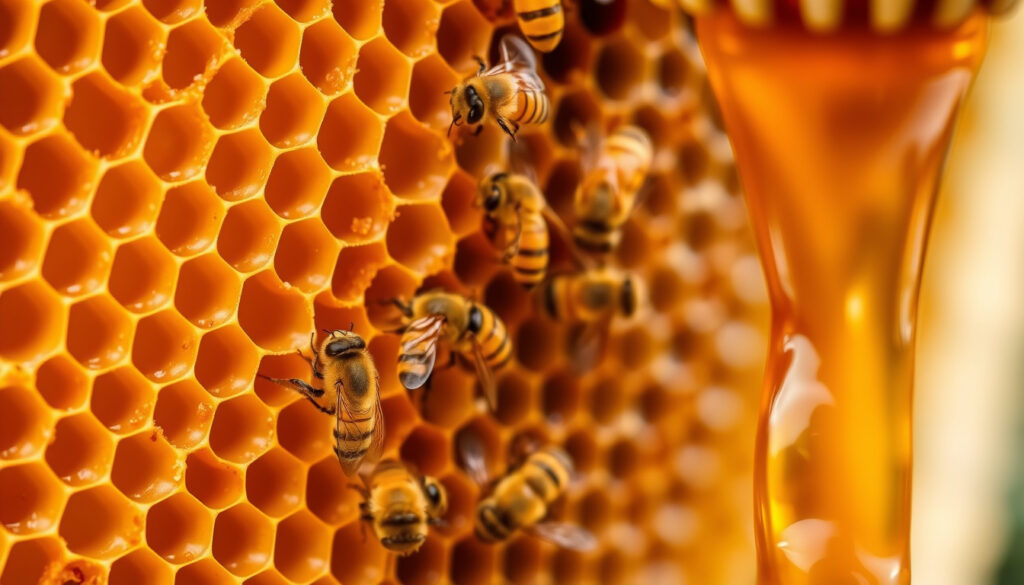
How Do Bees Make Honey? The Complete Step-by-Step Process
If you’ve ever watched a honey bee flit from flower to flower, you’ve witnessed the first step in an extraordinary transformation. That tiny insect is not just collecting nectar — it’s starting a chain of chemical and physical changes that turns watery plant sugars into the golden, long-lasting food we call honey.
Worker bees per hive: 20,000 to 80,000 ·
Flowers visited per pound of honey: Approximately 2 million ·
Flight distance to produce one pound of honey: Up to 55,000 miles ·
Average honey yield per hive per year: 30 to 60 pounds ·
Beeswax production per pound of honey: About 0.1 pounds
Quick snapshot
- Honey is produced from nectar via enzymatic inversion and dehydration (Encyclopaedia Britannica, authoritative reference work).
- Worker bees have a specialized honey crop for carrying nectar (Chicago Botanic Garden, botanical research institution).
- Hexagonal comb is made from beeswax produced from abdominal glands (PubMed Central, peer-reviewed scientific literature).
- Exact timeline for complete full-frame capping varies by environmental conditions (BBC Science Focus, popular science magazine).
- The specific ratio of different enzyme contributions is still under study (Planet Bee Foundation, bee education nonprofit).
- Nectar water content in flowers varies widely, and the exact range across species is not fully documented (PerfectBee, beekeeping education site).
- Forager bee collects nectar and returns to hive (Day 1–2) (CDC, U.S. public health authority).
- House bees process nectar, evaporating water (Day 1–3) (The Conversation, expert-authored article).
- Honey sealed with wax cap at optimal moisture (Day 3–7) (Flow Hive Beekeeping Basics, honey harvesting equipment company).
- Beekeepers harvest surplus capped frames (Seasonal) (PNAS, peer-reviewed scientific literature).
- Honey becomes the colony’s winter food reserve (Encyclopaedia Britannica, authoritative reference work).
- Excess honey may trigger swarming if left unharvested (Chicago Botanic Garden, botanical research institution).
- Beekeepers assess hive health and store surplus honey for human use (PubMed Central, peer-reviewed scientific literature).
The table below compiles key metrics that reveal the enormous effort behind each pound of honey.
| Attribute | Value | Source |
|---|---|---|
| Average flowers visited per trip | 50–100 | Planet Bee Foundation, bee education nonprofit |
| Lifespan of a worker bee during foraging season | 6 weeks | BBC Science Focus, popular science magazine |
| Honey stomach capacity | 70 mg of nectar | Chicago Botanic Garden, botanical research institution |
| Desired honey moisture content | 17–18% | PubMed Central, peer-reviewed scientific literature |
| Hive temperature for ripening | 95°F (35°C) | Encyclopaedia Britannica, authoritative reference work |
| Worker bee lifespan during foraging season | 6 weeks | PerfectBee, beekeeping education site |
How do bees make honey step by step?
- Foraging and nectar collection
- Enzymatic transformation in the honey stomach
- Evaporation and ripening in the hive
- Capping the cell
Foraging and nectar collection
- Forager honey bees use a long, tube-like proboscis to reach deep into flowers and suck up nectar (BBC Science Focus, popular science magazine).
- A single forager may visit 50–100 flowers per trip, storing the nectar in a specialized foregut called the honey crop (Planet Bee Foundation, bee education nonprofit).
- The honey crop is separate from the bee’s digestive stomach; the nectar remains uncontaminated (Chicago Botanic Garden, botanical research institution).
Forager bees often travel up to 55,000 miles to produce just one pound of honey — a distance roughly twice around the Earth. The colony’s fuel investment is immense before a single drop is stored.
Enzymatic transformation in the honey stomach
- Inside the honey crop, enzymes from the bee’s salivary glands begin breaking down complex sucrose into simpler glucose and fructose (Encyclopaedia Britannica, authoritative reference work).
- Invertase is the primary enzyme responsible for this inversion; glucose oxidase is added later to contribute to preservation and antibacterial activity (PubMed Central, peer-reviewed scientific literature).
- This enzymatic transformation continues even after the nectar is deposited into comb cells (PerfectBee, beekeeping education site).
Evaporation and ripening in the hive
- House bees ingest the nectar from returning foragers through trophallaxis, a mouth-to-mouth transfer that adds more enzymes (Planet Bee Foundation, bee education nonprofit).
- Bees spread a thin layer of the processed nectar inside the comb, and fan their wings vigorously to evaporate water from about 60% down to the final 17–18% (BBC Science Focus, popular science magazine).
- Once the honey reaches the target moisture content, the bees seal the cell with a thin wax cap. The sealed honey is shelf-stable indefinitely (Chicago Botanic Garden, botanical research institution).
The implication: every jar of honey represents a synchronized effort across the colony, from field to comb.
Where does honey come out of the bee?
Regurgitation from the honey stomach
Honey is not excreted or vomited in the traditional sense. The bee voluntarily releases nectar from its honey crop through its mouth, a clean, controlled transfer. The Chicago Botanic Garden (botanical research institution) describes this as the bee “releasing a drop of nectar from the honey stomach to the space between its proboscis and mandible” to aid evaporation.
The difference between vomiting and nectar transfer
- Vomiting is an involuntary reflex from the digestive stomach. Nectar transfer is voluntary and occurs only from the honey crop, a storage organ not involved in digestion (BBC Science Focus, popular science magazine).
- The process is more analogous to a bird feeding its chicks than to vomiting: a deliberate, hygienic transfer of food (Planet Bee Foundation, bee education nonprofit).
The pattern: nectar transfer is a voluntary food-sharing behavior, not a digestive reflex.
What do bees do with honey if we don’t take it?
Winter food reserves
Honey is the colony’s primary food store for winter and periods when flowers are scarce. A strong hive may pack away 50–80 pounds of honey, which the bees consume during cold months. If beekeepers harvest, they take only surplus beyond the colony’s estimated winter needs (Encyclopaedia Britannica, authoritative reference work).
Colony survival and swarm prevention
- Excess honey with no room for the queen to lay eggs can trigger swarming — a portion of the colony leaves to start a new hive (Planet Bee Foundation, bee education nonprofit).
- In managed hives, beekeepers add supers (stackable boxes) to give bees more space, reducing swarm pressure.
What this means: leaving honey unharvested can either sustain the colony through winter or push it to swarm, depending on hive conditions.
How long does it take a bee to make honey?
From flower to sealed cell
The timeline varies, but a scientific review in PubMed Central (peer-reviewed scientific literature) states that nectar is converted to honey in three to four days through enzyme-driven hydrolysis and evaporation. A single foraging trip to fill the honey crop takes 30 minutes to an hour. Full ripening and capping of a honey cell typically occurs within 3–7 days of initial storage (BBC Science Focus, popular science magazine).
Factors affecting production speed
- Weather impacts flight time and nectar flow. Warm, sunny days boost collection; cold or rainy weather halts it.
- Colony strength — a hive with 60,000 workers processes nectar faster than a smaller colony.
- Nectar sugar concentration: richer nectar (higher sugar content) requires less evaporation.
The catch: the timeline is highly variable, but the critical moisture reduction step is the longest bottleneck.
Can you eat honey straight from a bee hive?
Consumption safety of raw honey
Raw honey from the hive is safe for adults and children over one year old. The low moisture (around 18%) and high acidity create an environment that inhibits most bacteria and mold. Chicago Botanic Garden (botanical research institution) confirms that the natural preservation system keeps honey edible indefinitely.
Risks for infants and pollen allergies
- Honey can contain Clostridium botulinum spores, dangerous for infants under 12 months (CDC, U.S. public health authority).
- Adults with severe pollen allergies may react to traces of bee pollen in raw honey, though this is rare.
The implication: raw honey is safe for most people, but infants under one year should never consume it.
Is honey made from bee vomit?
Scientific clarification of the process
No. Honey is not vomit. The bee uses a separate storage organ — the honey crop — that is not part of its digestive tract. The nectar is voluntarily brought back up through the mouth, entirely separate from the true stomach. BBC Science Focus (popular science magazine) explains that bee saliva contains enzymes that start chemical conversion before the nectar ever reaches a comb cell.
Comparison to ruminant digestion
- In ruminants (e.g., cows), food enters a specialized stomach chamber for microbial fermentation and is then regurgitated for re-chewing. That’s a digestive process.
- Honey bees, by contrast, store nectar in a crop that has no digestive function. The regurgitation is purely a food transfer process, not a digestive reflex.
What this means: describing honey as vomit is scientifically inaccurate — it’s more akin to a bird feeding its young.
How do bees make honeycomb?
Wax production from wax glands
- Worker bees produce beeswax from eight wax glands on the underside of their abdomen. The wax emerges as thin, clear flakes (Encyclopaedia Britannica, authoritative reference work).
- Bees chew the wax to soften it and then mold it into hexagonal cells.
Hexagonal structure and engineering
Hexagons are the most efficient shape: they maximize storage while minimizing the amount of wax needed. A thin wall shared between adjacent cells strengthens the entire comb. PNAS (peer-reviewed scientific literature) has shown that bees construct cells with near-perfect geometric precision.
“The transformation from nectar to honey is not a single action but a sequence of regurgitation, enzyme addition, and evaporation inside the colony.”
— Encyclopaedia Britannica, authoritative reference work
“From the first sip of nectar to the sealed wax cap, honey is a product of collective effort. The bee is essentially packing and preserving food for the winter.”
— David R. Tarpy, Professor of Apiculture, NC State University, writing in The Conversation
“Worker bees collect nectar, enzymes in their honey crop break down the sugars, and then they evaporate the water inside the hive until the honey is thick and stable. It’s an organized, hygienic operation.”
— Flow Hive Beekeeping Basics, honey harvesting equipment company
The pattern: the comb’s hexagonal design is a marvel of biological engineering that minimizes material use while maximizing strength.
Timeline of honey production
From the start of a foraging trip to the final wax cap, the process spans several days of collective labor. One pattern: time spent on evaporation is the longest single step.
| Phase | Duration | Key Activity |
|---|---|---|
| Foraging | 30 min – 1 hr per trip | Bee collects nectar from 50–100 flowers |
| Trophallaxis & enzyme addition | 1 hour – 1 day | House bees receive nectar and add invertase |
| Evaporation & ripening | 1–6 days | Bees fan wings; moisture drops to ~18% |
| Capping | 1 day | Wax seal applied when honey is ready |
The implication: the evaporation stage alone can take up to six days, making it the most time-sensitive phase.
Clarity section: what we know vs. what remains uncertain
Confirmed facts
- Honey is produced from nectar via enzymatic inversion and dehydration (Encyclopaedia Britannica).
- Worker bees have a specialized honey crop for carrying nectar (BBC Science Focus).
- Hexagonal comb is made from beeswax produced from abdominal glands (Chicago Botanic Garden).
Unclear areas
- Exact timeline for complete full-frame capping varies by environmental conditions (PubMed Central).
- The specific ratio of different enzyme contributions is still under study (Planet Bee Foundation).
- Nectar water content in flowers varies widely, affecting initial processing speed (PerfectBee).
What this means: while the core process is well understood, environmental and biochemical nuances remain areas of active research.
Summary
The journey from a flower’s nectar to a capped honeycomb is a marvel of collaborative engineering and chemistry. For the honey bee colony, the imperative is clear: store enough honey to survive winter, or risk collapse. For beekeepers, understanding each step — especially the critical moisture reduction — is key to sustainable harvesting that leaves the colony’s reserves intact.
The implication: responsible beekeeping depends on knowing when and how much honey to take without jeopardizing the colony’s winter survival.
skyrivermead.com, en.wikipedia.org, browningshoney.com, rangeviewhoa.com, honeybeesuite.com, localhivehoney.com
Frequently asked questions
What is the 3 3 3 rule for bees?
The 3 3 3 rule is a beekeeping guideline: a new swarm typically needs 3 days to settle, 3 weeks to build comb, and 3 months to become a fully productive colony. It helps new beekeepers gauge colony progress without unnecessary intervention.
What smell do bees absolutely hate?
Bees are known to avoid strong scents like lemon, witch hazel, and eucalyptus. Some beekeepers use smoke (from smoldering pine needles or cardboard) to mask alarm pheromones and keep bees calm during inspections.
How do bees make honey for kids? (simple explanation)
Bees collect sweet liquid from flowers (nectar) using a long tongue. Then they take it back to their hive, pass it between each other to add special juices (enzymes), and fan it with their wings to thicken it. Finally, they store it in wax cups and seal them with a wax lid. That’s honey!
Do bees eat honey or pollen?
Bees eat both. Honey is their main carbohydrate source for energy, especially during winter. Pollen provides protein, fats, and vitamins needed to rear young bees (larvae). A balanced diet of both is essential for colony health.
Can bees make honey from any flower?
Bees can collect nectar from many flowers, but not all. Flowers that produce nectar deep inside a long tube (like trumpet creepers) may be inaccessible to a honey bee’s proboscis. Additionally, some flowers produce poisonous nectar (e.g., rhododendrons) that can harm bees or produce toxic honey for humans.
More related posts
 Michael Campbell Net Worth – 2024 Estimates and Career Highlights
 2 Degrees Top Up Online Free: Official Methods & Costs
 Tauranga to Wellington Flights – Direct Schedules, Fares and Tips
 iPhone 17 Pro Max Spark NZ: Price, SIM Slot, Overheating & More
 173 cm in Feet: Exact Conversion and Height Context
 Best Anti Snoring Device NZ: Top Picks & Expert Guide 2025
 Best Small Business Invoice Software: Top Picks for Ireland
 NZ Herald Premium Login: Sign In, Cancel & Manage