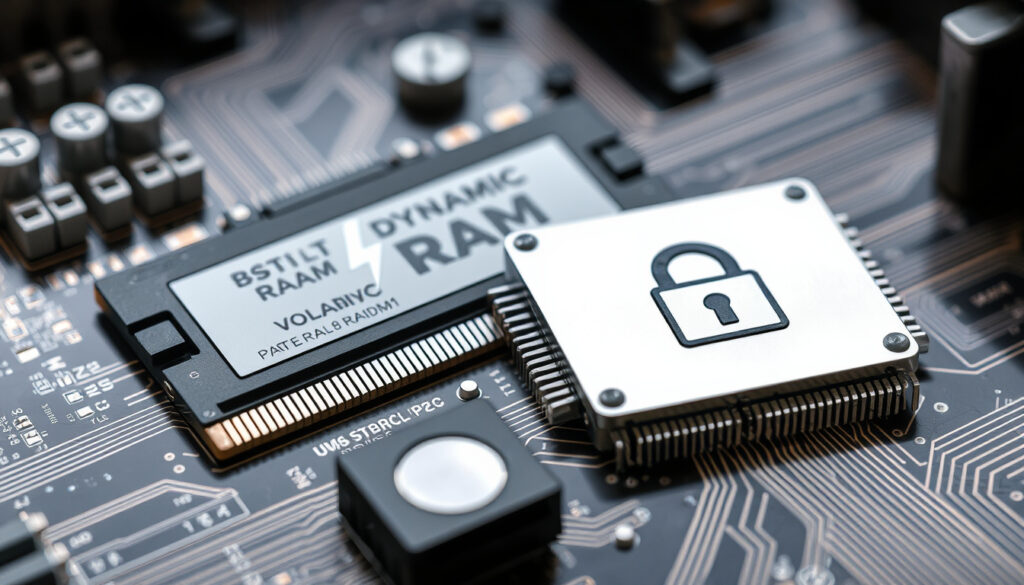
Difference Between RAM and ROM: 5 Key Differences Explained
If you’ve ever wondered why your phone slows down when too many apps are open, or why your computer can still turn on even after being unplugged, you’re already bumping into the difference between RAM and ROM. These two types of memory play very different roles in every device you own, from your smartphone to your laptop.
RAM stands for: Random Access Memory · ROM stands for: Read-Only Memory · RAM volatility: Volatile (data lost on power off) · ROM volatility: Non-volatile (retains data without power)
Quick snapshot
- RAM is volatile, ROM is non-volatile (HP Tech Takes, computer manufacturer resource)
- Data in RAM is lost when power is removed (HP Tech Takes)
- ROM stores BIOS/UEFI firmware (IP With Ease, networking and IT reference)
- Exact market share of volatile vs non-volatile memory types in 2025 (Enterprise Storage Forum, enterprise IT resource)
- Whether wear-leveling in EEPROM/Flash affects longevity for typical users (Testbook, educational test prep platform)
- 1951: First RAM patent (Jay Forrester) (Enterprise Storage Forum)
- 1950s: First ROM use in ENIAC and mainframes (Testbook)
- Average smartphone ROM now 128 GB; 256 GB becoming common (Unstop, academic learning platform)
- PC RAM baseline moving to 16 GB (Corsair, gaming and memory hardware brand)
Key facts at a glance
| Label | Value |
|---|---|
| First RAM patent | 1951 (Dynamical system of memory by Jay Forrester) |
| First ROM use in computers | 1950s (ENIAC and early mainframes) |
| Average smartphone RAM (2025) | 8 GB |
| Average smartphone ROM (2025) | 128 GB |
| Typical PC RAM | 16 GB |
| Typical PC boot ROM (UEFI) | 64 MB – 256 MB |
What are the 5 differences between RAM and ROM?
The five core differences boil down to volatility, use case, speed, capacity, and rewritability. Each one directly affects how your device feels during everyday use.
Volatility: RAM loses data; ROM retains it
- RAM is volatile — data disappears the instant power is cut (HP Tech Takes).
- ROM is non-volatile — it holds its contents whether the device is on or off (HP Tech Takes).
Primary use: RAM for active tasks, ROM for permanent instructions
- RAM stores data for currently running programs and the operating system (Corsair).
- ROM holds firmware and boot instructions — the code your device needs just to start (Major Differences, educational comparison site).
Speed: RAM is faster, ROM is slower
- RAM has access times of 20–100 nanoseconds depending on type (Enterprise Storage Forum).
- ROM is slower than RAM but still much faster than a hard drive (HP Tech Takes).
Capacity: RAM is larger in modern devices
- Modern PCs ship with 8–32 GB of RAM; smartphones typically 4–12 GB (Testbook).
- ROM (storage) in smartphones ranges from 64 GB to 512 GB, while PC BIOS ROM is only 64–256 MB (Unstop).
Re-writability: RAM is read/write, ROM is read-only (except in some variants)
- RAM can be written and erased millions of times (Corsair).
- ROM is typically written once during manufacturing, though variants like EEPROM and Flash allow rewriting under specific conditions (Testbook).
RAM handles the now — the apps you’re actively using. ROM takes care of the forever — the instructions your device needs to even turn on. If your phone stutters, you likely need more RAM. If you’re out of space for photos, you need more ROM.
What does 8GB RAM and 128GB ROM mean?
In smartphone and laptop specs phrases like “8GB RAM + 128GB ROM” describe two different kinds of memory working together. Here’s what each number actually means for performance.
Understanding RAM capacity in smartphones and computers
- 8GB RAM is the working memory your device uses to run apps and the operating system in real time (Corsair).
- With 8GB, you can comfortably multitask: switch between a browser, a messaging app, and streaming video without reloading (HP Tech Takes).
Understanding ROM (storage) capacity
- 128GB ROM refers to the internal storage — the space that permanently holds your photos, downloaded apps, music, and the operating system itself (Unstop).
- 128GB is enough for an average user’s app collection plus several thousand photos, though heavy media users may need 256GB or more.
How 8GB RAM and 128GB ROM work together
- When you open an app, it loads from ROM (storage) into RAM for fast access. The app’s data lives in RAM while you use it; when you close it, updates are saved back to ROM (Testbook).
- If RAM fills up, the device either closes old apps or gets sluggish. If ROM fills up, you can’t install new apps or save new files.
A phone with 8GB RAM and 128GB ROM strikes a practical balance: enough working memory to keep everyday apps snappy, and enough storage for a couple of years’ worth of photos and downloads. Power users should lean toward 12–16GB RAM and 256GB ROM.
Is it better to have more RAM or more ROM?
The answer depends entirely on what you do with your device. There is no universal winner — just trade-offs.
When more RAM is beneficial
- More RAM improves multitasking: you can keep a dozen browser tabs, a video editor, and a music app open at the same time (Enterprise Storage Forum).
- Gamers and video editors benefit most from larger RAM — games and rendering tools are memory hungry (Corsair).
When more ROM (storage) is critical
- If you shoot lots of video, download movies offline, or install many large games, extra ROM prevents the dreaded “storage full” warning (Unstop).
- For general productivity, 8–16GB RAM is a baseline; heavy users of media need larger ROM (HP Tech Takes).
Balancing RAM and ROM for different use cases
- Home office worker: 8GB RAM + 256GB ROM — enough speed for office apps, enough storage for documents and occasional media.
- Gamer: 16–32GB RAM + 512GB ROM — RAM for smooth gameplay, ROM for game installations.
- Photographer / videographer: 16GB RAM + 1TB ROM — large RAM for editing, massive storage for files.
The implication: your workload decides the ratio, not a single rule.
Why is ROM better than RAM?
“Better” depends on the job. ROM has three clear advantages over RAM that make it indispensable for certain tasks.
Non-volatility: ROM retains data without power
- ROM’s biggest strength: your phone keeps its operating system and boot code even when the battery dies. RAM would forget everything (HP Tech Takes).
Stability and security of firmware in ROM
- Because ROM is hard to modify, it’s ideal for critical firmware like the BIOS/UEFI — the first code your PC runs. Malware can’t easily overwrite it (IP With Ease).
Cost effectiveness for permanent storage
- ROM (especially NAND flash) is far cheaper per gigabyte than RAM. You can buy 1TB of SSD storage (a modern ROM form) for about the same price as 16GB of DDR5 RAM (Testbook).
What this means: ROM wins on persistence, security, and cost — but it cannot match RAM’s speed for active work.
How much RAM do I need?
RAM needs have shifted upward in recent years. Here’s a practical guide by workload.
Minimum RAM for basic tasks (4–8GB)
- 4GB RAM is suitable for light web browsing, email, and office work — but expect slowdowns with multiple tabs open (Corsair).
Standard RAM for productivity (8–16GB)
- 8GB RAM is the recommended baseline for most users in 2025–2026 (HP Tech Takes).
- 16GB RAM handles gaming and moderate content creation comfortably (Enterprise Storage Forum).
High-end RAM for gaming and creation (16–32GB)
- 32GB RAM is for heavy multitasking, professional video editing, and modern AAA gaming with background apps (Corsair).
Extreme RAM for servers and workstations (64GB+)
- 128GB RAM is overkill for typical consumers but useful for virtual machines, large database work, and scientific computing (Testbook).
More RAM costs more and can increase power consumption, but the performance gain for gamers and creators is undeniable. For casual use, 8GB hits the sweet spot; professionals should aim for 16–32GB.
Comparison table: RAM vs ROM
Seven features, one pattern: RAM prioritizes speed and rewritability, ROM prioritizes permanence and cost.
| Feature | RAM | ROM |
|---|---|---|
| Volatility | Volatile (data lost on power off) | Non-volatile (data retained) |
| Primary use | Active program data and OS | Firmware and boot instructions |
| Speed (typical access) | 20–100 ns | Slower than RAM; faster than HDD |
| Capacity (consumer devices) | 4–32 GB | 64 MB (BIOS) – 1 TB (storage) |
| Re-writability | Read/write, millions of cycles | Read-only in standard form; Flash/EEPROM writable |
| Cost per GB | Higher | Lower |
| Typical examples | DDR5, LPDDR5 | UEFI, NAND flash (SSD, eMMC) |
The pattern: RAM trades volatility for blistering speed; ROM trades speed for reliable persistence. One can’t replace the other — they’re complementary.
Quotes from industry voices
“RAM is the temporary workspace where your computer operates on current tasks. More RAM means you can work on more things at once.” For a deeper dive into the distinctions between RAM and ROM, explore this piece on James Watt inventor and entrepreneur.
— Corsair, memory hardware brand
“ROM contains the critical instructions your device needs to start up and run its basic functions. Without it, your computer wouldn’t know how to boot.”
— HP Tech Takes, tech resource from a leading computer manufacturer
“The fundamental difference is that RAM is volatile and loses data when power is off, while ROM is non-volatile and retains data even after a shutdown.”
— GeeksforGeeks, computer science education portal
Clarity: What’s confirmed and what’s not
Confirmed facts
- RAM is volatile, ROM is non-volatile (HP Tech Takes)
- Data in RAM is lost when power is removed (HP Tech Takes)
- ROM stores BIOS/UEFI firmware (IP With Ease)
- RAM speed is measured in MHz or GHz (Enterprise Storage Forum)
- ROM capacity is measured in GB or MB (Testbook)
What’s unclear
- Exact market share of volatile vs non-volatile memory types in 2025 (Enterprise Storage Forum)
- Whether wear-leveling in EEPROM/Flash affects longevity for typical users (Testbook)
Summary
RAM and ROM serve complementary roles: RAM provides the blazing-fast, temporary workspace your device needs for active tasks; ROM delivers the permanent, stable storage for firmware and personal files. For the average buyer, the choice between a smartphone with 8GB RAM and 128GB ROM or one with 12GB RAM and 64GB ROM comes down to a simple trade-off: more RAM for smoother multitasking, or more ROM for storing photos and apps. The right decision hinges on whether you are a heavy app user or a heavy media collector — and that difference can save you hundreds of dollars or hours of frustration.
Frequently asked questions
Can RAM be upgraded in a smartphone?
Most modern smartphones have RAM soldered to the motherboard, making it non-upgradable. Some older or niche models allowed expansion, but this is rare as of 2025.
Is ROM the same as storage on a phone?
Yes — in smartphone marketing, “ROM” refers to the internal storage (e.g., 128GB ROM) where your apps, photos, and OS live. It’s technically flash memory, a type of EEPROM.
What happens if you fill up your RAM?
When RAM is full, your device uses a part of the storage as virtual memory, which is much slower. This causes apps to reload, stuttering, or even crashes.
Can ROM be reprogrammed after manufacturing?
Standard Mask ROM cannot be changed, but variants like EPROM, EEPROM, and flash memory can be reprogrammed — though with limited write cycles.
How does RAM affect gaming performance?
Insufficient RAM forces the system to swap data with storage, causing stutters and longer load times. 16GB is now the recommended baseline for modern games.
Is more ROM always better for a PC?
For storage (SSD/HDD), more ROM allows you to keep more files and games. However, once you have enough for your needs, extra ROM doesn’t improve performance — unlike RAM, which directly affects speed.
What is the difference between ROM and flash memory?
Flash memory is a type of EEPROM that can be electrically erased and rewritten in blocks. It’s faster than traditional ROM and is used for SSDs and phone storage, though it still retains data without power.
More related posts
 Mag and Turbo Hamilton: Prices, Reviews and Services
 Auckland Anniversary Day 2026: Date, Regions & Events
 Kids Birthday Party Venues Auckland: Indoor & Outdoor Options
 Police Welfare Check McSkimming: IPCA Report & Key Facts
 Convert PDF to Word Free: Top Online Converter Tools
 Central Otago Real Estate: Buyer’s Market Guide
 NCEA Exam Timetable 2026: Dates, PDF & NZQA Guide
 London to Rome Vistas: Epic Tour vs Direct Travel